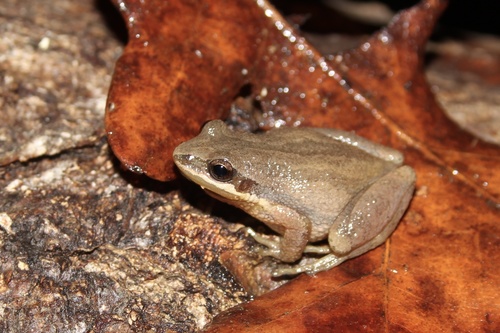
Upland Chorus Frog
Pseudacris feriarum
The Upland Chorus Frog is the invisible herald of spring, filling the cool night air with its iconic comb-like call. Though small and expertly camouflaged, these resilient amphibians are common visitors to backyard wetlands and wooded edges.
Quick Identification
Size
0.75 to 1.5 inches (1.9 to 3.8 cm) in length
Colors
Varies from brown and tan to grey or olive green. Features three dark, longitudinal stripes down the back which may be broken into spots. A distinct white line runs along the upper lip.
Key Features
- Three dark stripes or rows of spots down the back
- A dark mask-like stripe running through the eye to the shoulder
- White stripe on the upper lip
- Small, inconspicuous toe pads compared to other tree frogs
When You’ll See Them
Behavior
The Upland Chorus Frog is a secretive, primarily nocturnal amphibian that is far more often heard than seen. They are famous for their breeding call, which sounds remarkably like a person running their fingernail over the teeth of a stiff plastic comb. This sound is a staple of early spring nights in the eastern United States, often beginning while there is still snow on the ground. Unlike many larger frogs, they do not spend much time in permanent bodies of water, preferring the safety of temporary, fish-free 'vernal' pools for breeding.
Outside of the breeding season, these frogs are quite terrestrial. They spend their time foraging through leaf litter and tall grasses. They are not strong climbers and generally stay close to the ground, hiding under logs, rocks, or debris to maintain moisture. While they are wary of humans and will fall silent if they sense heavy footsteps nearby, they can become quite accustomed to a quiet observer with a flashlight or a well-placed backyard camera.
EverydayEarth exclusive
Camera Tips
Capturing the Upland Chorus Frog on camera requires a ground-level approach. Because these frogs rarely exceed an inch and a half in length, you should place your camera no higher than 2 to 4 inches off the ground. If your camera allows for it, use a macro lens or a close-focus setting, as the frog will likely be very close to the lens. Aim the camera toward a known 'singing post'—usually a small tuft of grass or a twig emerging from a shallow puddle or damp depression in your yard.
Since these frogs are most active after spring rains, timing is everything. Set your camera to record video rather than still photos. A 15-second video clip is much more likely to capture their throat sac inflating during a call than a single photo. Use the highest sensitivity setting for your motion trigger, as these tiny frogs may not create enough heat or movement to trigger standard settings. If your camera has a 'time-lapse' mode, consider setting it to take a photo every 30 seconds during a rainy evening in March.
To attract them to a specific spot for your camera, create a 'frog hotel' using a pile of damp, decaying logs or a shallow, sunken saucer of dechlorinated water surrounded by leaf litter. Avoid using bright white-light flashes if possible, as this can startle them and stop their calling behavior; instead, utilize infrared (IR) or 'no-glow' settings. If you are using a camera that records audio, you’ll be able to identify them easily by their 'crreeeeeek' rising-pitch call, which provides a great soundtrack to your nocturnal footage.
Similar Species
Species that look similar or are commonly confused with Upland Chorus Frog.
Spring Peeper
Look for the dark 'X' mark on the back and a high-pitched 'peep' call instead of stripes and a comb-like sound.
Western Chorus Frog
Nearly identical visually; differentiation is primarily based on geography, with Western species found further inland toward the plains.
New Jersey Chorus Frog
Has much longer stripes that are rarely broken into spots and slightly longer hind legs.
Frequently Asked Questions
Record Upland Chorus Frog at your habitat
Connect a camera to start building your own species record — AI identifies every visitor automatically.