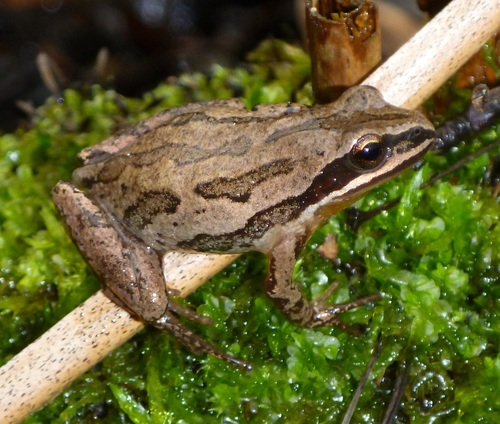
Western Chorus Frog
Pseudacris triseriata
The Western Chorus Frog is the tiny, striped herald of spring, famous for a call that sounds like a comb's teeth clicking. These elusive singers turn shallow backyard ponds into nightly orchestras long before the first leaves appear.
Quick Identification
Size
1.9 to 3.8 cm (0.75 to 1.5 inches) in length; weighs approximately 1 to 2 grams
Colors
Tan, grey, or olive-green base; three dark brown or charcoal longitudinal stripes down the back; a dark stripe through the eye and a white line on the upper lip
Key Features
- Three dark, often broken, stripes running down the back
- Dark horizontal mask-like stripe through the eye
- Small, slender body with a white line along the upper lip
- Relatively small toe pads compared to other tree frogs
When You’ll See Them
Behavior
Despite belonging to the tree frog family, they are not strong climbers and spend almost all their time on the ground or in low-lying vegetation. They are highly sensitive to vibration and will fall silent and submerge themselves at the slightest hint of a predator or human approach. Outside of the breeding season, they become even more elusive, moving into meadows and forests where they hide under logs, leaf litter, or in loose soil.
EverydayEarth exclusive
Camera Tips
Because frogs are cold-blooded, traditional Passive Infrared (PIR) sensors often fail to trigger. To bypass this, set your camera to 'Time Lapse' mode during the evening hours of the early spring breeding season. A 2-minute or 5-minute interval is usually sufficient to catch them in position. If your camera has a high-sensitivity setting for its motion sensor, make sure it is turned to the maximum level to give you the best chance of a heat-and-motion trigger.
Lighting is another challenge; the infrared flash on many trail cameras can be too powerful at close range, resulting in 'blown out' white images of the frog. To fix this, place a small piece of semi-transparent tape or a piece of white plastic milk jug over the IR flash to diffuse the light. This will create a softer glow that reveals the frog's stripes and skin texture without overexposing the shot. If your camera records video, ensure audio is enabled to capture their iconic comb-like trill.
Placement timing is everything. Deploy your gear on the first warm, rainy nights of late winter or early spring when the temperature rises above 40°F (4°C). Look for males sitting on partially submerged sticks or at the base of cattails; they tend to return to the same calling spots night after night. By targeting these specific perches, you can increase your success rate significantly without needing to bait the area.
Similar Species
Species that look similar or are commonly confused with Western Chorus Frog.
Spring Peeper
Look for a dark 'X' mark on the back rather than three vertical stripes.
Boreal Chorus Frog
Nearly identical, but the Boreal variety has shorter hind legs and the stripes are more likely to be broken into spots.
Wood Frog
Much larger with a very prominent dark 'robber's mask' over the eyes and no stripes down the back.
Frequently Asked Questions
Record Western Chorus Frog at your habitat
Connect a camera to start building your own species record — AI identifies every visitor automatically.