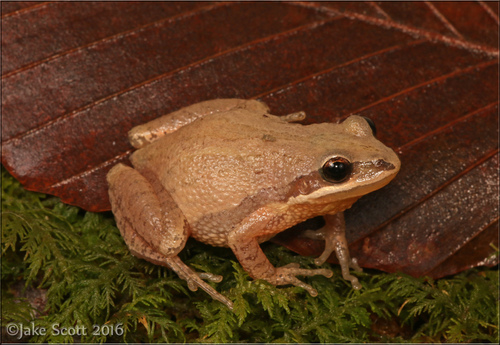
New Jersey Chorus Frog
Pseudacris kalmi
The New Jersey Chorus Frog is the tiny, striped herald of spring, famous for a call that sounds like a plastic comb. This elusive neighbor transforms backyard puddles into vibrant nurseries long before the first flowers bloom.
Quick Identification
Size
0.75 to 1.5 inches (1.9 to 3.8 cm) in length
Colors
Grey, tan, or greenish-brown base color. Features a prominent dark brown or black stripe running from the snout through the eye to the groin, and three dark stripes down the back.
Key Features
- Dark mask-like stripe from snout to groin
- Three dark longitudinal stripes on the back
- White line along the upper lip
- Granular skin texture on the belly
When You’ll See Them
Behavior
The New Jersey Chorus Frog is a secretive, primarily terrestrial species that is far more likely to be heard than seen. They are among the earliest amphibians to emerge in the late winter, often beginning their breeding calls while ice still lingers on the edges of ponds. Their distinctive call sounds remarkably like a fingernail being dragged across the teeth of a stiff plastic comb, rising in pitch at the end.
Outside of the brief and loud breeding season, these frogs lead a quiet life tucked away in leaf litter or under fallen logs. They are not particularly adept climbers compared to other treefrogs, preferring to stay close to the ground where they can hunt for small invertebrates. While they are wary of human presence, they can thrive in suburban backyards that maintain natural debris and avoid heavy pesticide use.
EverydayEarth exclusive
Camera Tips
Capturing the New Jersey Chorus Frog on camera requires a ground-level strategy. Because these frogs are tiny and have a body temperature that mimics the environment, traditional PIR (Passive Infrared) motion sensors may struggle to detect them. The most effective method is to use a camera with a 'Time Lapse' or 'Field Scan' feature, set to take a photo every 1 to 2 minutes during rainy nights in early spring. This bypasses the need for the frog to trigger a sensor.
Position your camera only 3-5 inches off the ground, angled slightly downward toward a cleared patch of damp earth or the edge of a shallow puddle. If you are using an AI-powered camera like a Birdfy or similar backyard device, try placing it near a pile of damp logs or a 'toad abode.' Use a macro lens attachment if your camera supports it, as these frogs are small enough that they may appear as mere specks on a standard wide-angle trail camera.
To increase your chances, focus on 'wet' weather. These frogs are most active during and immediately after light rain showers when the humidity is high. Look for areas in your yard where water naturally pools after a storm. If you have a backyard pond, place the camera near the shallowest, grassiest edge rather than the deep center, as this is where they congregate to call and mate.
Lastly, ensure your camera's night vision is set to 'low glow' or use a soft external light source if possible. While they are focused on breeding, they are less easily spooked, but harsh white flashes can cause them to freeze or retreat. Setting your camera to record short video clips (10-15 seconds) is often better than photos, as the movement and the distinctive 'creaking' sound in the audio will help you confirm the species identity.
Similar Species
Species that look similar or are commonly confused with New Jersey Chorus Frog.
Spring Peeper
Identified by a dark, 'X'-shaped mark on the back and a high-pitched, whistling peep call.
Upland Chorus Frog
Very similar in appearance, but usually has spots or broken lines on its back rather than solid stripes.
Western Chorus Frog
Nearly identical, but geographically separated; the New Jersey Chorus Frog is generally larger with longer legs.
Frequently Asked Questions
Record New Jersey Chorus Frog at your habitat
Connect a camera to start building your own species record — AI identifies every visitor automatically.