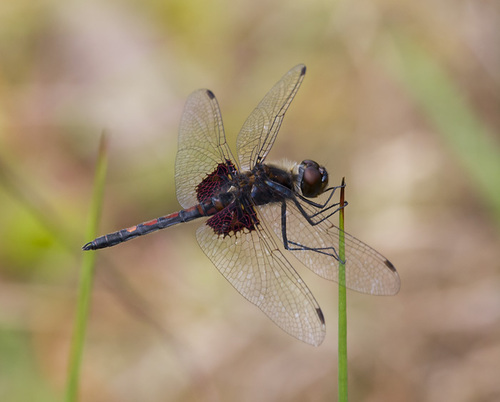
Ornate Pennant
Celithemis ornata
A jewel of the wetlands, the Ornate Pennant dazzles with its ruby-red spots and delicate wing patterns. This small but fierce predator is a favorite for backyard observers looking to spot the 'pennant' of the insect world.
Quick Identification
Size
Length: 28–34 mm (1.1–1.3 in); Wingspan: 50–60 mm (2.0–2.4 in)
Colors
Mature males feature a black body with vibrant red triangular spots on the abdomen; females and juveniles have yellow spots. Both sexes have dark patches at the base of the hindwings.
Key Features
- Distinctive dark, ornate patches at the base of the hindwings
- Vibrant red or yellow spots along the top of the abdomen
- Small, slender build compared to larger skimmers
- Habit of perching on the very tips of vertical vegetation
When You’ll See Them
Behavior
The Ornate Pennant is a master of the 'sit-and-wait' predatory style. Unlike some dragonflies that spend hours on the wing, this species prefers to find a prominent perch—typically the tip of a tall blade of grass or a thin twig—where it can survey its surroundings for prey. It gets its name from this behavior, as it often looks like a tiny flag or pennant blowing in the breeze while it clings to the vegetation.
These dragonflies are highly territorial, particularly the males, who will aggressively defend their preferred perching spots from rivals. When a potential meal like a gnat or mosquito flies by, the Ornate Pennant launches into a lightning-fast aerial pursuit, capturing the insect in its legs before returning to its perch to eat. They are generally wary of humans but can be approached slowly if you avoid casting a shadow over them.
EverydayEarth exclusive
Camera Tips
Capturing the Ornate Pennant on an AI-powered backyard camera requires a specific setup because of their small size and perching habits. Unlike birds or mammals, these dragonflies won't be triggered by a camera placed on a tree trunk. To successfully photograph them, you should place a 'target' perch about 3 to 4 feet away from your camera lens. A thin bamboo stake or a dried tall grass stem works perfectly. Ensure this perch is the tallest object in the immediate area, as they instinctively head for the highest point to get a better view of prey.
Since these insects are ectothermic (cold-blooded), they are most active when the sun is hitting their perches directly. Position your camera and the target perch in a spot that receives full sun during the middle of the day. For the best color saturation, try to have the sun at your back so it illuminates the red spots and the intricate wing patterns. If your AI camera allows for manual focus or zone setting, focus specifically on the top 2 inches of your target stake, as that is exactly where the Ornate Pennant will land.
Using a high-speed trigger or video mode is essential. Dragonflies move with incredible acceleration, and a slow shutter or laggy PIR sensor will often result in a shot of an empty twig. Set your camera to take short 10-second clips or high-frequency bursts. If you are near water, aim the camera toward the shoreline where the bog meets the grass. You don't need bait—in fact, traditional baits won't work—but keeping a small, still water feature or a damp, boggy patch in your yard can encourage them to stick around your property.
During the peak of summer, watch for 'obelisking' behavior, where the dragonfly points its abdomen straight up toward the sun to reduce its surface area and stay cool. This makes for a unique and dramatic photo. If you are using a trail camera, ensure it has a macro lens attachment or a close-focus capability (within 2-5 feet), otherwise, this small dragonfly will appear as nothing more than a tiny speck in the frame.
Similar Species
Species that look similar or are commonly confused with Ornate Pennant.
Calico Pennant
The Calico Pennant has dark markings scattered across the entire wing, rather than just at the base of the hindwings.
Halloween Pennant
Much larger with orange-tinted wings and broad black bands, making it look like a butterfly in flight.
Amanda's Pennant
Very similar but lacks the dark face of the mature Ornate Pennant male and has slightly different wing spot shapes.
Frequently Asked Questions
Record Ornate Pennant at your habitat
Connect a camera to start building your own species record — AI identifies every visitor automatically.