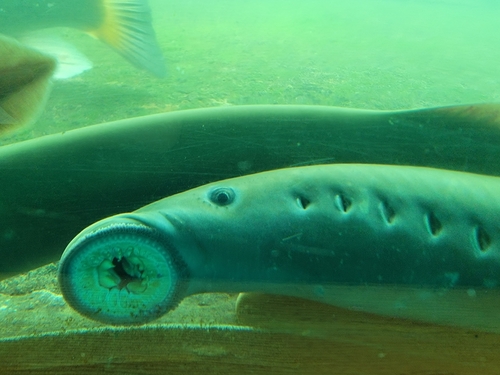
Pacific Lamprey
Entosphenus tridentatus
A prehistoric survivor of the Pacific Rim, the Pacific Lamprey is a 'living fossil' that has navigated our waterways for over 400 million years. These eel-like voyagers are essential ecosystem engineers, connecting the deep ocean to the heart of our mountain forests.
Quick Identification
Size
Adults typically range from 38 to 76 cm (15 to 30 inches) and weigh between 0.2 and 0.5 kg (0.4 to 1.1 lbs).
Colors
Slate blue to dark gray or mottled brown on the dorsal side, fading to a pale silver or white belly.
Key Features
- Eel-like body without scales
- Three distinct teeth on the supraoral bar
- Seven small, circular gill pores behind the eyes
- Suctorial mouth used for attaching to rocks and prey
When You’ll See Them
Geographic range
Where Does the Pacific Lamprey Live?
The Pacific Lamprey is native to the Pacific Rim, spanning a massive geographic arc from Japan and Russia across the Bering Strait to Alaska, and south through Canada to Baja California, Mexico. In the United States, they are most famously associated with the Columbia River Basin and coastal streams of the Pacific Northwest, where they migrate hundreds of miles inland to reach high-elevation spawning grounds.
Basemap © OpenStreetMap contributors
Behavior
The Pacific Lamprey is an anadromous species, meaning it spends its adult life in the ocean before returning to freshwater rivers and streams to spawn. Unlike many migratory fish, they do not always return to their exact natal streams but instead follow chemical cues (pheromones) released by larvae already present in the water. They are largely nocturnal, using the cover of darkness to navigate upstream and avoid predators like seals, eagles, and larger fish. During their migration, they exhibit remarkable physical strength, using their suctorial mouths to scale vertical rock faces and waterfalls.
Once they reach their spawning grounds, Pacific Lampreys engage in communal nest-building. They use their suction-cup mouths to physically move stones, creating a depression in the gravel known as a redd. After spawning, the adults typically die within a few days to weeks, providing a massive influx of marine-derived nutrients to the local freshwater ecosystem. The larvae, called ammocoetes, live buried in the silt for several years, acting as vital filter feeders that improve water quality.
EverydayEarth exclusive
Camera Tips
Capturing a Pacific Lamprey on camera requires an underwater setup or a very specific bank-side placement near shallow stream crossings. If you live near a coastal or inland river in the Pacific Northwest, look for clear, shallow 'riffles' where the water is only a few inches deep over gravel. Position your camera on a waterproof tripod or a weighted mount on the riverbed, aiming it across the gravel bed during the spring spawning season. Because lampreys are primarily nocturnal, ensure your camera has high-quality infrared (IR) night vision to capture their movement without scaring them with white light.
For those using backyard creek cameras, look for natural bottlenecks in the stream, such as narrow passages between large rocks or the base of small waterfalls. Pacific Lampreys are famous for 'climbing' wet surfaces using their mouths; a camera angled at a damp, vertical rock face during a migration peak can yield incredible footage of this unique behavior. Avoid using bait, as migrating adults do not eat; instead, rely on identifying the physical signs of their presence, such as small circular depressions in the riverbed gravel where they have been moving stones.
If you are filming from above the water, use a circular polarizing filter on your lens to cut through the surface glare. This is essential for seeing into the water during the day, though most of your best footage will likely come from the night. Set your camera to video mode rather than stills, as the sinuous, eel-like swimming motion of the lamprey is its most distinguishing feature and is difficult to capture effectively in a single frame. Ensure your trigger sensitivity is high, as they can move surprisingly quickly through fast-moving water.
Similar Species
Species that look similar or are commonly confused with Pacific Lamprey.
Frequently Asked Questions
Record Pacific Lamprey at your habitat
Connect a camera to start building your own species record — AI identifies every visitor automatically.