Western River Lamprey
Occidentis ayresii
A prehistoric survivor of the Pacific Northwest, the Western River Lamprey is a jawless wonder that links the deep ocean to inland rivers. Discover the secret life of this metallic-hued migrator as it navigates our coastal streams.
Quick Identification
Size
15–31 cm (6–12 inches) in length; weighs approximately 10–50 grams.
Colors
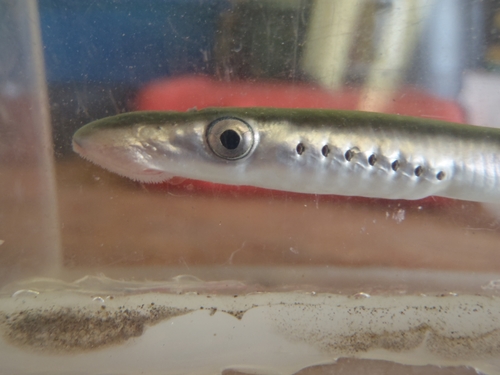
Metallic dark blue or olive-grey on the dorsal side, bright silver on the flanks, and a white or cream belly.
Key Features
- Eel-like body without scales or paired fins
- Circular suction-disk mouth with sharp, rasping teeth
- Seven small, circular gill openings on each side behind the head
When You’ll See Them
Geographic range
Where Does the Western River Lamprey Live?
The Western River Lamprey is a specialist of the Pacific coast of North America, found from the Aleutian Islands in Alaska down through the coastal regions of British Columbia, Washington, and Oregon, reaching as far south as the Sacramento-San Joaquin River system in California. They primarily inhabit the lower reaches of large rivers and the brackish waters of estuaries where freshwater meets the sea. Unlike their cousins that venture far into the open ocean, these lampreys tend to stay closer to the coastline, making them a unique resident of the immediate Pacific littoral zone.
Basemap © OpenStreetMap contributors
Behavior
The Western River Lamprey is a fascinating jawless fish that bridges the gap between freshwater and marine ecosystems. During their adult phase, they are opportunistic parasites, using their suction-cup mouths to latch onto larger fish such as Pacific Herring or young Salmon. They use a specialized tongue to rasp away at their host's tissue, though they typically detach before the host is killed, acting more like a temporary hitchhiker than a lethal predator in many cases.
Socially, lampreys are mostly solitary until the spawning season. They spend several years as larvae (ammocoetes) buried in the mud of river bottoms, where they act as nature’s cleaners by filter-feeding on organic debris. Once they transform into adults, they migrate to the ocean or estuaries to feed, eventually returning to the gravelly beds of rivers to spawn and complete their life cycle. Interactions with humans are rare, as they are shy, primarily nocturnal, and hidden beneath the water's surface.
EverydayEarth exclusive
Camera Tips
Capturing a Western River Lamprey on camera is a specialized challenge that requires an underwater setup or a very clear view of a shallow, gravelly stream bed. To succeed, place your AI-powered camera in a waterproof housing near 'riffles'—shallow, fast-moving sections of the river where lampreys are likely to spawn. During the late spring spawning season, they use their mouths to move stones to build nests, providing excellent opportunities for action shots of their unique physical capabilities.
Because these fish are highly nocturnal, integrated infrared (IR) lighting is essential. A camera positioned at a 45-degree angle to the water's surface can minimize glare if you aren't using an underwater rig. If you have a backyard creek that meets an estuary, focus your efforts on the 'tail-outs' of pools where the water slows down before a faster drop-off, as lampreys often rest here during their upstream journey.
Since lampreys are attracted to specific pheromones rather than traditional food, 'baiting' isn't practical for home users. Instead, timing is everything. Set your camera to record high-frame-rate video bursts rather than still photos. This helps capture their unique undulating swimming motion and the distinct way they use their suction mouths to grip rocks. Check your local water levels; a slight rise in water temperature or a post-rain flow often triggers a surge in lamprey movement.
For technical settings, prioritize a high ISO sensitivity if your camera allows it, as the IR light needs to penetrate the water column. Ensure your motion trigger sensitivity is set to 'high,' as the sleek, slender body of a lamprey may not always trigger sensors designed for larger mammals. If you are using an AI-model for detection, ensure it is trained on aquatic silhouettes or 'eel-like' movements to avoid missing these swift, silver visitors.
Similar Species
Species that look similar or are commonly confused with Western River Lamprey.
Frequently Asked Questions
Record Western River Lamprey at your habitat
Connect a camera to start building your own species record — AI identifies every visitor automatically.