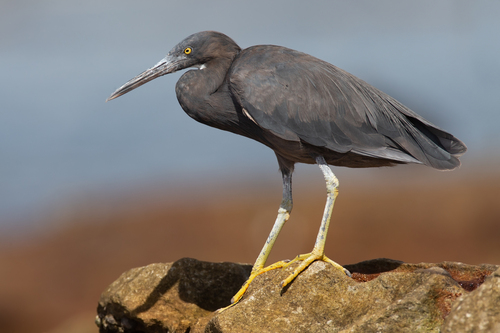
Pacific Reef Heron
Egretta sacra
The Pacific Reef Heron is a stoic sentinel of the shoreline, appearing in two striking color phases. Whether stalking tide pools in charcoal grey or pure white, this coastal specialist is a master of the low-tide hunt.
Quick Identification
Size
Length: 57–66 cm (22–26 in); Wingspan: 90–110 cm (35–43 in); Weight: 330–700 g (0.7–1.5 lbs)
Colors
Two distinct color morphs: charcoal or slaty grey with a small white throat streak, or entirely pure white. Both have yellowish-green legs and a grey to yellow-brown bill.
Key Features
- Two distinct color phases (grey and white)
- Thick, relatively short yellowish-green legs
- Heavy, dagger-like bill
- Low-slung, crouched hunting posture
When You’ll See Them
Behavior
The Pacific Reef Heron is a master of the intertidal zone, known for its incredible patience and specialized hunting techniques. Unlike many other herons that stand tall and still, this species typically adopts a low, hunched posture, creeping stealthily across exposed reef flats or rocky shorelines. They are solitary hunters, often establishing and defending a specific stretch of coastline where they follow the ebb and flow of the tide to catch prey trapped in shallow pools.
While generally wary of humans in remote areas, they can become remarkably habituated in coastal suburban settings or near boat ramps where scraps might be available. Their flight is distinctive—heavy and low to the water with slow, methodical wingbeats. Interestingly, the choice of color morph (white or grey) doesn't affect social behavior; grey and white individuals frequently pair up, and a single clutch of eggs can produce chicks of both plumage types.
EverydayEarth exclusive
Camera Tips
To successfully capture the Pacific Reef Heron on a backyard or trail camera, your placement must be dictated by the ocean's rhythm rather than the clock. If you have a property that borders a rocky shore or reef flat, identify the 'pinch points' where tide pools form as the water recedes. These are the heron’s primary grocery stores. Position your camera on a low-profile mount or a weighted base just above the high-tide line, angling it downward toward the pools. A low camera angle (12–18 inches from the ground) is essential to capture their characteristic crouched hunting stance and the intense focus in their eyes.
Lighting is your biggest challenge with this species, particularly because of the two color morphs. The white morph can easily 'blow out' and lose all detail in bright midday sun, while the charcoal morph can appear as a featureless silhouette in deep shadow. Aim your camera north or south to avoid direct sun glare off the water, and try to capture them during the golden hours of dawn and dusk when the light is soft. If your camera has adjustable exposure settings, underexposing by a half-stop can help preserve the delicate details in the feathers of a white-morph bird.
While you shouldn't use food as bait due to the delicate nature of coastal ecosystems, you can use 'structural lures.' Placing a flat, dark rock in a shallow area can create a natural perch that the heron may use to get a better vantage point over a pool. Use a high-speed trigger setting or a 'burst mode' to catch the lightning-fast strike when they lunge for fish. Because coastal air is highly corrosive, ensure your camera is housed in a high-quality weather shield and wipe the lens frequently to remove salt spray residue, which can blur your images over time.
Similar Species
Species that look similar or are commonly confused with Pacific Reef Heron.
Little Egret
The Little Egret is more slender with longer black legs and distinctive yellow feet, whereas the Reef Heron is stockier with shorter, greenish legs.
White-faced Heron
The White-faced Heron is grey with a bright white face and yellow legs, lacking the solid charcoal or pure white plumage options of the Reef Heron.
Striated Heron
Much smaller and more hunched, the Striated Heron has a dark cap and heavily streaked neck, typically preferring mangroves over open reefs.
Frequently Asked Questions
Record Pacific Reef Heron at your habitat
Connect a camera to start building your own species record — AI identifies every visitor automatically.