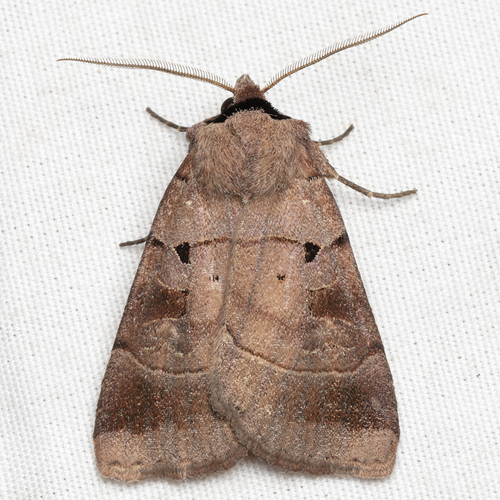
Pale-banded Dart
Agnorisma badinodis
A signature species of the autumn night, the Pale-banded Dart is recognized by its chocolate-colored wings and elegant, high-contrast markings. It is a frequent visitor to backyard light stations across the eastern half of North America.
Quick Identification
Size
Wingspan of 32–40 mm (1.25–1.5 inches); total body length approx. 18–22 mm
Colors
Rich chocolate-brown or reddish-brown forewings with creamy-tan or pale gray markings; hindwings are a uniform dusky grayish-brown
Key Features
- Two prominent pale-outlined spots (orbicular and reniform) on the forewing
- A distinct pale, thin subterminal line near the wing edge
- Dark triangular or square patch between the wing spots
- Stocky, hairy body typical of Noctuidae moths
When You’ll See Them
Geographic range
Where Does the Pale-banded Dart Live?
Native to the North American continent, the Pale-banded Dart is a staple of the eastern landscape. It is found throughout southern Canada and the United States, stretching from the Atlantic coast westward to the 100th meridian. Its population is most concentrated in the Northeast and Midwest, though it is notably absent from the high-heat environments of the Deep South and the arid Western states.
Basemap © OpenStreetMap contributors
Behavior
The Pale-banded Dart is a member of the 'owlet' moth family, characterized by its strictly nocturnal habits and its tendency to be most active during the cooler nights of late summer and early autumn. Unlike many insects that fade away as the season turns, this species thrives in the transition to fall, using its dark, earthy coloration to blend perfectly with fallen leaves and tree bark during the day.
In the larval stage, this species is known as a 'cutworm.' These caterpillars are notorious for hiding in the soil during the day and emerging at night to clip off young plants at the base. As adults, they are strong and direct fliers, often traveling significant distances to find food or mates. They are highly attracted to artificial light sources and fermenting organic matter, making them easy to observe for those with the right setup.
EverydayEarth exclusive
Camera Tips
To successfully capture the Pale-banded Dart on your AI camera, timing is everything. These moths are 'fall specialists,' so ensure your equipment is active from late August through October. Since they are nocturnal, you will need a camera with a high-quality infrared (IR) sensor. Position your camera facing a vertical surface, such as a white sheet or a light-colored tree trunk, which provides a clean background for the AI to identify the moth's distinct wing patterns.
The most effective way to draw them in is through 'sugaring.' Create a thick, fermented bait by mixing overripe bananas, brown sugar, and a splash of beer. Paint this mixture onto a tree trunk at eye level and mount your camera roughly 3 to 5 feet away. This 'bait station' will encourage the moths to land and remain still for several minutes, allowing your camera to capture high-resolution images rather than just a blurry flight path.
If you are using a light-based attractant, place a UV or 'black light' near your camera's field of view. Be aware that moths move very quickly when circling lights; to get a clear shot, set your camera's trigger interval to the shortest possible time (0.5 to 1 second) and use a high-speed photo burst mode. Avoid placing the camera too close to the light source to prevent 'white-out' glare on the insect's wings, which can obscure the pale bands necessary for identification.
Similar Species
Species that look similar or are commonly confused with Pale-banded Dart.
Frequently Asked Questions
Record Pale-banded Dart at your habitat
Connect a camera to start building your own species record — AI identifies every visitor automatically.