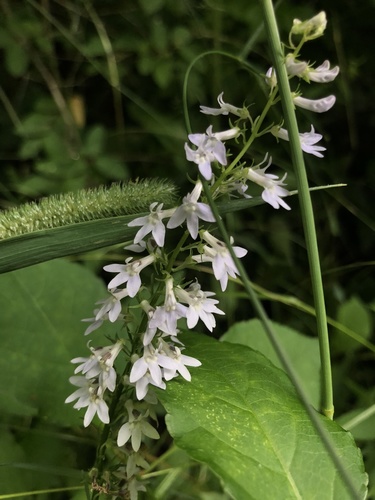
pale-spiked lobelia
Lobelia spicata
With its slender spikes of ethereal blue, the pale-spiked lobelia is a quiet masterpiece of the summer prairie. This hardy native wildflower is a favorite of delicate pollinators and a stunning subject for close-up photography.
Quick Identification
Size
Stands 30–90 cm (1–3 feet) tall; individual flowers are approximately 1 cm (0.4 inches) long.
Colors
Pale blue to light lavender or white flowers; medium-green foliage and stems.
Key Features
- Slender, unbranched upright central stalk
- Dense terminal spike of small, two-lipped tubular flowers
- Lower petal is divided into three distinct lobes
- Alternate, lance-shaped leaves that get smaller near the top
When You’ll See Them
Behavior
Pale-spiked lobelia is a delicate but sturdy wildflower that brings a touch of vertical interest to the mid-summer landscape. As a biennial or short-lived perennial, it often spends its first year as a inconspicuous low-growing rosette of leaves, waiting for the following summer to send up its distinctive flowering spike. It is remarkably adaptable, often found swaying in the breeze of open prairies, meadows, and even along the edges of suburban lawns where the soil remains relatively undisturbed.
While the plant itself is stationary, it acts as a vital social hub for local insect populations. It has evolved a specialized 'piston' mechanism for pollination; when a bee enters the flower to reach the nectar, the anthers brush pollen onto the insect's back. This species is particularly favored by small native bees and various species of skippers and butterflies, making it a wonderful 'stakeout' point for anyone interested in observing the micro-movements of backyard pollinators.
EverydayEarth exclusive
Camera Tips
To get the best shots of pale-spiked lobelia, you need to account for its height and slender profile. Position your camera on a short tripod or a ground-level stake mount, roughly 18 to 24 inches from the main spike. Because the flowers are small and the stem is thin, even a light breeze can cause the plant to bob out of focus. If your camera has a 'Pro' or manual mode, use a fast shutter speed (1/500s or higher) to freeze the motion of both the plant and the fast-moving pollinators that visit it.
Lighting is crucial for this species because of its pale color. The delicate lavender or white petals can easily 'blow out' and lose detail in harsh, direct midday sun. For the most professional look, set your camera to capture images during the 'Golden Hour'—just after sunrise or before sunset. The low-angle light will catch the fine hairs on the stem and provide a soft glow to the translucent petals. If you are using a motion-activated camera for pollinators, ensure it is positioned so the sun is behind the camera to avoid lens flare.
Because the lobelia spike blooms from the bottom upward, the best time to start your camera project is in early June. A time-lapse set to one frame every hour can create a stunning visual record of the 'ascending' bloom over several weeks. For wildlife enthusiasts, this plant is an excellent 'bait' for insect photography. You don't need food lures; the nectar is the draw. Set your trigger sensitivity to 'High' and use a narrow detection zone focused specifically on the flower spike to avoid capturing every blade of grass moving in the background.
Lastly, consider the background. Pale-spiked lobelia often grows in crowded meadows. If possible, position your camera so there is significant distance between the lobelia and the vegetation behind it. This creates a 'bokeh' effect, where the background is softly blurred, making the slender purple spike pop in your photos and videos. If the plant is in a particularly windy spot, a small, discreet bamboo stake placed behind the stem and tied with a soft green wire can help stabilize it for clearer long-exposure shots.
Similar Species
Species that look similar or are commonly confused with pale-spiked lobelia.
Frequently Asked Questions
Record pale-spiked lobelia at your habitat
Connect a camera to start building your own species record — AI identifies every visitor automatically.