Paramecium
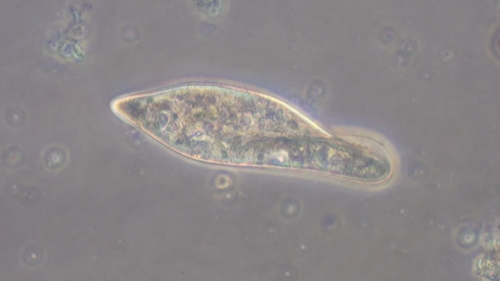
Paramecium caudatum
Step into the hidden world of the 'Slipper Animalcule.' Though invisible to the naked eye, Paramecium caudatum is a sophisticated predator that brings high-speed action to every drop of backyard pond water.
Quick Identification
Size
0.17 to 0.33 mm (0.007 to 0.013 inches) in length
Colors
Translucent or greyish-white; often appears silvery or slightly golden under direct light with a grainy internal texture
Key Features
- Distinctive slipper-shaped body with a rounded front and pointed rear
- Thousands of tiny, rhythmic hair-like cilia covering the surface
- A deep, funnel-like oral groove on the side of the body
- Pulse-like contractile vacuoles visible at both ends
When You’ll See Them
Behavior
Paramecium caudatum is a master of the microscopic world, known for its constant and rapid movement. It propels itself through the water using its cilia like thousands of tiny oars, rotating as it swims to maintain a straight path. When it encounters an obstacle, it exhibits a fascinating 'avoidance reaction': it reverses, pivots at a slight angle, and moves forward again until it finds a clear path. This simple yet effective behavior allows it to navigate complex environments like pond debris or submerged moss.
While they are unicellular organisms, their feeding behavior is surprisingly complex. They use their cilia to create a miniature vortex, drawing bacteria and small particles into their oral groove. Inside the cell, food is packed into vacuoles that circulate through the body like a conveyor belt, distributing nutrients before waste is expelled. Though they are solitary hunters, you will often find them congregating in massive numbers around decaying organic matter where their bacterial prey is most abundant.
EverydayEarth exclusive
Camera Tips
Capturing Paramecium on camera requires a shift in perspective, moving from traditional trail cams to 'micro-wildlife' setups. For the best results, use a digital microscope camera or a high-magnification macro lens attached to your smartphone. The key is to collect a 'backyard safari' sample: take a jar of water from a pond or birdbath, ideally including a bit of decaying leaf litter or pond scum where Paramecium love to graze. Let the jar sit for 24 hours in a room with indirect sunlight to allow the organisms to congregate near the surface.
Lighting is the most critical factor for a clear shot. Traditional top-down lighting often washes out their translucent bodies. Instead, try 'darkfield' illumination by lighting your sample from the side or slightly from below at an angle. This makes the Paramecium glow against a dark background, highlighting their beating cilia and internal vacuoles. If your AI-powered camera supports high frame rates, use them; these creatures move surprisingly fast, and a high shutter speed is necessary to freeze their motion without blur.
To attract a higher density of Paramecium for your camera, you can create a 'protozoan infusion.' Add a few grains of uncooked rice or a piece of dried grass to your water sample. This stimulates a massive bacterial bloom, which in turn acts as an irresistible lure for Paramecium. Within a few days, the water will be teeming with life. Set your camera to a fixed focus on a thin layer of water—a concave microscope slide works best—to ensure the organisms stay within the narrow depth of field while you record their frantic, fascinating world.
Similar Species
Species that look similar or are commonly confused with Paramecium.
Amoeba proteus
Amoebas lack a fixed shape and move by slowly oozing rather than swimming with cilia.
Stentor coeruleus
Stentors are much larger, trumpet-shaped, and usually blue-tinted compared to the translucent Paramecium.
Euglena gracilis
Euglena are typically bright green and move using a single whip-like tail (flagellum) rather than hundreds of cilia.
Frequently Asked Questions
Record Paramecium at your habitat
Connect a camera to start building your own species record — AI identifies every visitor automatically.