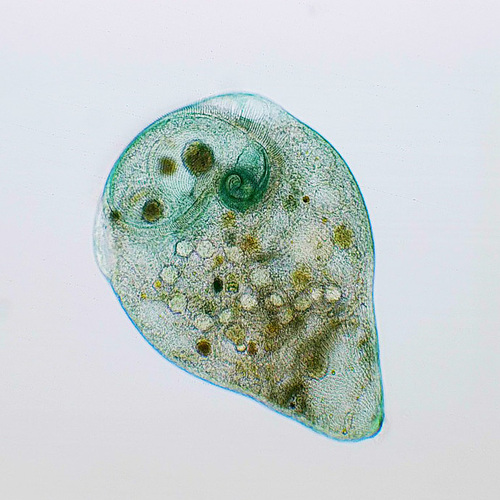
Stentor coeruleus
Stentor coeruleus
The Blue Stentor is a majestic giant of the microscopic world, boasting a brilliant cerulean hue and a graceful trumpet-shaped body. Easily one of the most beautiful organisms you can find in a drop of pond water, it’s a master of regeneration and a vital part of your backyard’s hidden ecosystem.
Quick Identification
Size
0.5 to 2.0 mm (0.02 to 0.08 inches) in length when fully extended.
Colors
Vibrant cerulean or deep trumpet-blue; translucent when stretched, appearing darker and more opaque when contracted.
Key Features
- Iconic trumpet or horn-shaped body
- Dense ring of cilia around the wide 'mouth' or frontal field
- Vibrant blue-green pigmentation from the stentorin protein
- Often found attached to submerged debris by a narrow holdfast
When You’ll See Them
Behavior
Stentor coeruleus is one of the giants of the microscopic world, a single-celled organism that behaves with surprising complexity. Most often, it lives a sessile life, anchoring its narrow base to pond weeds, submerged leaves, or decaying twigs. Once attached, it stretches its body into a majestic trumpet shape and uses its crown of beating cilia to create a miniature whirlpool, drawing in bacteria and smaller protists. While it prefers to stay put, it is fully capable of detaching and swimming gracefully through the water column using its body-wide cilia.
Remarkably, this species is a favorite of scientists due to its incredible regenerative abilities; a single Stentor can be cut into pieces, and each piece containing a portion of its bead-like macronucleus will grow back into a complete, perfectly formed individual. In the backyard pond ecosystem, they act as vital cleaners, keeping bacterial populations in check while providing a food source for small invertebrates like rotifers and water fleas.
EverydayEarth exclusive
Camera Tips
Capturing the Stentor coeruleus requires a departure from standard trail cameras and a move into the world of high-magnification macro photography or digital microscopy. To find them, collect a jar of water from a healthy backyard pond, specifically targeting the 'biofilm'—the slippery coating on submerged leaves or the underside of lily pads. Let the jar sit for an hour; Stentors will often gravitate toward the light or attach themselves to the glass walls, appearing as tiny, bright blue specks barely visible to the naked eye.
For the best results, use a digital microscope camera or a smartphone equipped with a 20x or higher macro lens. If you are using a dedicated microscope, use 'darkfield illumination' if available. This technique lights the specimen from the side against a dark background, making the Stentor’s brilliant blue pigment glow vibrantly while highlighting the delicate cilia. If you're shooting through a jar, place a black card behind the glass and light it from a 45-degree angle to create a similar high-contrast effect.
Because these organisms are sensitive to heat, avoid using high-intensity incandescent bulbs which can cook the water sample; cool LED lighting is essential for long-term observation. If you want to capture their 'trumpet' shape, patience is key. When disturbed, they contract into a tiny blue ball. Give them several minutes of stillness to relax and extend back to their full, majestic length. Setting your camera to record time-lapse footage is a fantastic way to document their feeding behavior and the hypnotic movement of their ciliary crown.
Similar Species
Species that look similar or are commonly confused with Stentor coeruleus.
Frequently Asked Questions
Record Stentor coeruleus at your habitat
Connect a camera to start building your own species record — AI identifies every visitor automatically.