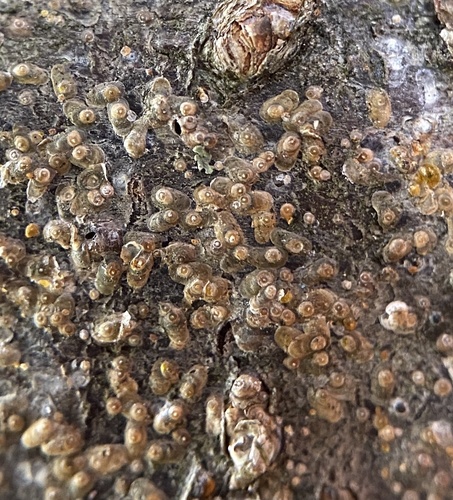
Pernicious Scale
Comstockaspis perniciosa
The Pernicious Scale is a tiny but tenacious inhabitant of the backyard orchard. Though individually microscopic, these 'armored' insects create fascinating colonies that tell a story of survival and adaptation.
Quick Identification
Size
Adult female scales are 1-2 mm (0.04-0.08 inches) in diameter; males are smaller and winged.
Colors
Circular gray or brownish-gray waxy covers with a raised yellow or orange central 'nipple'.
Key Features
- Circular, slightly convex waxy shell
- Distinct raised central point or 'nipple'
- Causes bright red or purple spots on fruit and bark
- Forms dense, crust-like colonies on branches
When You’ll See Them
Behavior
The Pernicious Scale, famously known as the San Jose scale, leads a remarkably sedentary life for an insect. Once a female crawler finds a suitable spot on a host tree, she tucks her legs under her body, inserts her straw-like mouthparts into the plant tissue, and never moves again. She secretes a hard, waxy shield for protection against the elements and predators. This stationary existence makes them difficult to spot until their population grows into a thick, crusty layer on the tree's bark.
Unlike the females, adult males eventually develop wings and emerge from their scales to fly and find mates, though they live for only a few hours. These insects are highly efficient at draining plant nutrients, and they are notorious in the agricultural world for being the first species to develop a documented resistance to chemical insecticides back in 1914. In a backyard setting, they are most often noticed by the distinctive red halos they leave on ripening fruit.
EverydayEarth exclusive
Camera Tips
Capturing the Pernicious Scale on camera requires a specialized approach because of their microscopic size. Standard trail cameras will likely miss them, so we recommend using an AI-powered macro camera or a smartphone with a high-quality macro lens attachment. Position your camera just inches away from the bark of a suspected host tree—look for areas where the bark looks unusually 'scaly' or ashy. Using a tripod or a fixed mount is essential, as the depth of field at this magnification is extremely narrow.
To capture the most exciting 'action,' time your monitoring for late May or early June. This is when the first generation of 'crawlers' (tiny yellow nymphs) emerges from under the mother scales. These are the only mobile phase of the female life cycle and appear as tiny moving yellow dots. Set your camera to time-lapse mode, taking a photo every 30 seconds, to witness the slow but steady colonization of a new branch. High-resolution video can also capture the rare sight of the winged males as they flutter around the stationary females.
Lighting is your best friend when documenting these insects. Because their waxy shells are textured, side-lighting (placing a light source at a 45-degree angle to the bark) will create shadows that make the circular scales pop against the bark's surface. Avoid using a direct front flash, which can wash out the subtle yellow central nipple that is the key identifier for this species. If you are monitoring for tree health, take consistent photos of the same branch over several weeks to track the spread of the colony and the appearance of the tell-tale red spotting.
Similar Species
Species that look similar or are commonly confused with Pernicious Scale.
Frequently Asked Questions
Record Pernicious Scale at your habitat
Connect a camera to start building your own species record — AI identifies every visitor automatically.