Phacus
Phacus orbicularis
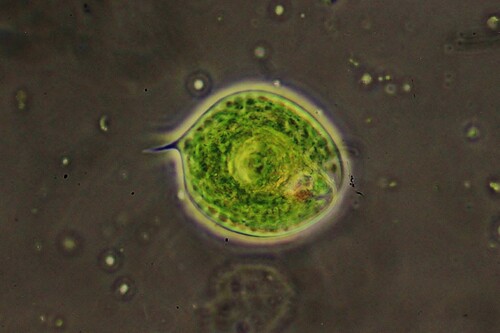
Meet the pancake of the pond—a vibrant, disk-shaped microorganism that blurs the line between plant and animal. Phacus orbicularis is a microscopic marvel that brings a splash of emerald green to still waters.
Quick Identification
Size
50–100 micrometers (µm) in length; invisible to the naked eye without magnification.
Colors
Vibrant emerald green due to numerous chloroplasts; features a small, bright red 'eyespot' (stigma) near the front.
Key Features
- Flat, disk-like or orbicular body shape
- Long, whip-like flagellum used for locomotion
- Rigid, striated pellicle with visible longitudinal rows
- Distinctive red light-sensing eyespot
When You’ll See Them
Behavior
Phacus orbicularis is a fascinating single-celled organism that behaves like a hybrid between a plant and an animal. It spends its day gliding through the water column using its flagellum—a long, hair-like structure—to propel itself with a graceful, spinning motion. Unlike its cousin Euglena, Phacus has a rigid outer layer called a pellicle, which means it maintains its flat, pancake-like shape rather than squishing and stretching as it moves.
These organisms are highly sensitive to light, using a specialized red eyespot to navigate toward the optimal intensity for photosynthesis. While they are primarily solitary, they can congregate in massive numbers in nutrient-rich waters, contributing to the green 'bloom' often seen on the surface of stagnant ponds. They are non-toxic and serve as a vital foundation for the microscopic food web, feeding tiny crustaceans and insect larvae.
EverydayEarth exclusive
Camera Tips
Capturing Phacus orbicularis requires a departure from standard trail camera setups. To 'photograph' this species, you will need a digital microscope or a high-magnification smartphone microscope attachment capable of at least 100x to 400x magnification. Since these organisms are microscopic, your 'camera trap' starts with a water sample. Use a small glass jar to collect water from the surface of a still pond, specifically targeting areas where the water looks slightly green or 'soupy.'
For the best results, place a drop of your pond water on a concave microscope slide. To keep the Phacus in frame, you may need to use a 'slowing agent' like Methyl Cellulose (ProtoSlow), which increases the viscosity of the water and prevents the organism from swimming out of your field of view too quickly. Position your light source from below to highlight the internal chloroplasts and the striations on the pellicle.
If you are using an AI-powered smart microscope, set your capture trigger to record short 10-second clips. This allows you to observe the unique swirling swimming pattern that distinguishes Phacus from other algae. High-contrast or dark-field lighting settings are particularly effective for making the transparent edges of the cell body pop against the background. Late spring and summer are the best times for sampling, as warm temperatures and high nutrient levels trigger population booms.
Similar Species
Species that look similar or are commonly confused with Phacus.
Phacus pleuronectes
Very similar but usually smaller with a more pronounced, curved tail-like 'cauda' at the posterior end.
Euglena gracilis
Lacks the rigid disk shape of Phacus; it is highly flexible and can stretch its body into a long worm-like shape.
Lepocinclis ovum
Has an oval, egg-like shape rather than the flat, compressed disk shape of Phacus orbicularis.
Frequently Asked Questions
Record Phacus at your habitat
Connect a camera to start building your own species record — AI identifies every visitor automatically.