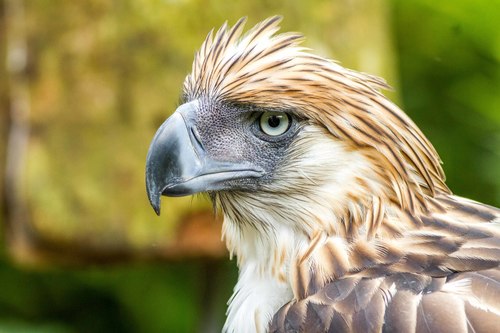
Philippine Eagle
Pithecophaga jefferyi
Witness the power of the world's most majestic bird of prey. With its iconic shaggy crest and massive wingspan, the Philippine Eagle is the ultimate symbol of the archipelago's ancient, wild rainforests.
Quick Identification
Size
Length of 86-102 cm (2.8-3.3 ft); wingspan up to 2 meters (6.6 ft); weight of 4.04-8.0 kg (8.9-17.6 lbs)
Colors
Rich dark brown upperparts with lighter edging; creamy white underparts; bluish-gray beak; pale gray-blue eyes
Key Features
- Distinctive shaggy, mane-like crest of feathers
- Large, high-arched bluish-gray bill
- Massive yellow legs with powerful black talons
- Broad, powerful wings and a long, rounded tail
When You’ll See Them
Sightings on EverydayEarth
Jul 4, 2026
A Philippine Eagle is perched on a wooden beam, looking around its environment. It remains alert, occasionally turning its head to scan the surroundings, with its distinctive crest and powerful beak clearly visible in the bright sunlight.
Jul 4, 2026
Two Philippine Eagles are seen resting at night within their sanctuary. One eagle is positioned in a detailed foreground close-up, occasionally blinking and shifting its head, showing off its iconic shaggy crest. A second eagle is perched further back on a wooden beam, remaining alert and observing the surroundings.
Jul 4, 2026
Two Philippine Eagles are perched quietly at night. One eagle is in the immediate foreground, providing a detailed view of its head and crest as it blinks and looks around. A second eagle is perched further back on a wooden beam, looking off to the side.
Jul 4, 2026
Two Philippine Eagles are resting within their enclosure. One eagle is positioned in the immediate foreground with its back to the camera, displaying its distinctively long and shaggy crest. A second eagle is perched on a wooden beam in the background, where it is observed preening its wing feathers.
Jul 4, 2026
Two Philippine Eagles are perched in their enclosure during the night. One bird is positioned very close to the camera in the foreground, turning its head to reveal its iconic crest and large beak, while a second bird remains perched and stationary on a wooden structure in the background.
Jul 4, 2026
Two Philippine Eagles are seen resting at night. One eagle is perched on a wooden beam in the background, while another is positioned very close to the camera in the foreground, with its shaggy crest feathers clearly visible in the infrared light.
Behavior
The Philippine Eagle is a solitary and fiercely territorial apex predator, often referred to as the 'King of the Birds' in its native range. Unlike many large raptors that prefer open plains, this eagle is a master of the dense tropical canopy. It uses its broad wings and long tail to navigate through thick foliage with surprising agility, often hunting from a hidden perch where it can ambush prey with a sudden burst of speed.
These eagles are famous for their lifelong monogamy and deep devotion to their offspring. A mated pair requires a massive territory of old-growth forest—often exceeding 50 square miles—to support a single chick, which they raise only once every two years. Because of their slow reproductive rate and extreme sensitivity to human disturbance, they are rarely seen near settled areas and remain one of the most elusive large birds in the world.
EverydayEarth exclusive
Camera Tips
Capturing the Philippine Eagle on a trail camera is a high-level challenge due to their preference for the high forest canopy. Standard ground-level deployments are unlikely to yield results. Instead, focus on 'bottleneck' areas in the forest, such as ridgelines or clearings near emergent trees that tower above the rest of the canopy. These emergent trees are often used as strategic lookout perches. If possible, mounting a camera 30 to 50 meters high in a neighboring tree, angled toward a known perch, is the most effective strategy.
Technical specifications are critical for this species. Use a camera with a lightning-fast trigger speed (0.3 seconds or less) to capture the eagle as it lands or dives. Because the lighting in a tropical rainforest can be challenging—with bright sky patches contrasting against dark foliage—set your camera to a high dynamic range (HDR) mode if available. Aim for high-resolution 4K video clips, as these provide the best opportunity for researchers to identify individual birds through their unique crest shapes or leg bands.
Environmental protection for your gear is a must. The high humidity of the Philippine rainforest can quickly destroy electronics. Use heavy-duty, waterproof housings and include multiple large desiccant packs inside the camera to prevent lens fogging. Given the remote nature of their habitat, high-capacity solar panels and oversized SD cards are recommended to minimize the need for frequent site visits, which can disturb the birds.
Finally, always prioritize ethics and conservation. Avoid using any form of bait or lure, as this can alter the bird's natural hunting behavior or attract ground predators to sensitive areas. If you are lucky enough to locate a nesting site, cameras must be placed at a significant distance (at least 300 meters) using telephoto-capable remote systems. The goal is to document this critically endangered species without ever making your presence known.
Similar Species
Species that look similar or are commonly confused with Philippine Eagle.
Frequently Asked Questions
Record Philippine Eagle at your habitat
Connect a camera to start building your own species record — AI identifies every visitor automatically.