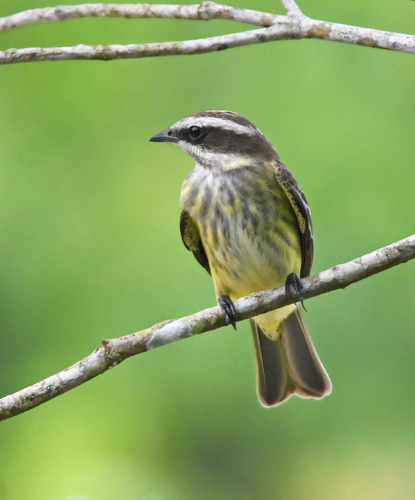
Piratic Flycatcher
Legatus leucophaius
A tiny bird with a big attitude, the Piratic Flycatcher is the bandit of the bird world. It foregoes building its own home, instead using persistent harassment to 'pirate' the nests of other species.
Quick Identification
Size
Length: 14.5–15 cm (5.7–6 in); Wingspan: 25–28 cm (10–11 in); Weight: 22–28 g (0.8–1.0 oz)
Colors
Dusky olive-brown upperparts; white throat and prominent white eyebrow (supercilium); dark eye mask; pale yellow underparts with heavy brown streaking on the breast and flanks.
Key Features
- Bold white eyebrow and dark eye mask
- Stubby black bill, shorter than most flycatchers
- Heavy dark streaking on breast and sides
- Upright posture often perched high in canopy
When You’ll See Them
Behavior
The Piratic Flycatcher earns its name through its unique and aggressive breeding strategy known as kleptoparasitism. Unlike most passerines, this bird does not build its own nest. Instead, it identifies the elaborate, enclosed nests of other species—such as Oropendolas, Caciques, or Social Flycatchers—and relentlessly harasses the owners until they abandon their home. Once the original owners are driven away, the Piratic Flycatcher moves in, often tossing out any existing eggs or chicks.
Despite their small size, they are incredibly persistent and vocal during these takeovers, frequently seen dive-bombing birds much larger than themselves. Outside of their nesting antics, they are generally solitary or found in pairs. They are canopy-dwellers that spend much of their time perched on high, exposed branches, making them more often heard than seen. Their call is a distinctive, high-pitched, thin whistling sound that carries well through the forest edge.
EverydayEarth exclusive
Camera Tips
To successfully capture a Piratic Flycatcher on your AI-powered camera, you must think vertically. These birds rarely descend to ground level or even the lower shrub layer. Position your camera at a height of at least 10–15 feet, or higher if you can safely mount it in a tree. Focus the lens on high, horizontal branches that provide a clear view of the surrounding canopy, as these are the bird’s preferred lookout points for both hunting insects and spotting potential nests to pirate.
Since these birds are attracted to existing nests, the ultimate 'bait' isn't food, but the presence of other nesting birds. If you have Oropendola nests or the bulky, domed nests of Great Kiskadees nearby, aim your camera directly at those structures. The Piratic Flycatcher will often spend hours perched nearby, screaming at the residents. If you are using a backyard feeder setup, you are unlikely to see them unless you have fruiting trees like Mistletoe or Ficus; in that case, aim your camera at the fruit clusters during the dry season when they are most likely to visit for a meal.
Regarding camera settings, the bright tropical or summer sky often creates a difficult backlighting situation for birds in the canopy. To avoid getting a silhouette, position your camera with the sun at its back (facing North or South) and ensure your AI camera’s 'Wide Dynamic Range' (WDR) or exposure compensation is set to favor the darker areas of the frame. Because they are fast-moving 'sallying' flyers, use a high shutter speed or a 'Sports' trigger mode to catch the moment they dive for an insect or fruit. Early morning is the best time for recording, as this is when their vocalizations are most frequent, helping the AI detect their presence.
Similar Species
Species that look similar or are commonly confused with Piratic Flycatcher.
Streaked Flycatcher
Much larger with a heavier bill and distinct reddish-brown (rufous) coloring in the tail and wings.
Social Flycatcher
Lacks the heavy breast streaking and has a much cleaner yellow belly and darker head.
Variegated Flycatcher
Slightly larger with a longer bill and more extensive rufous edging on the wing feathers and tail.
Frequently Asked Questions
Record Piratic Flycatcher at your habitat
Connect a camera to start building your own species record — AI identifies every visitor automatically.