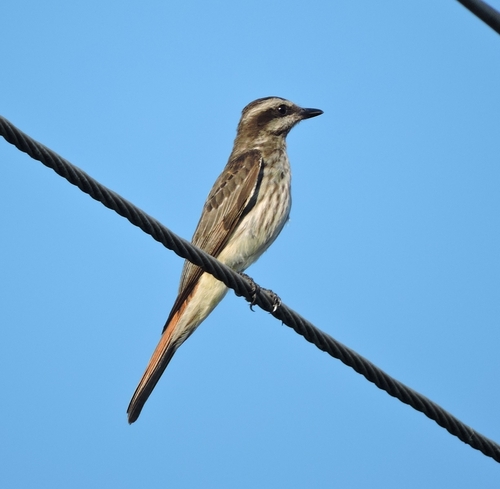
Variegated Flycatcher
Empidonomus varius
A master of the aerial ambush, the Variegated Flycatcher is a striking, streaked visitor that brings a touch of South American flair to the garden canopy. Known for its bold 'eyebrows' and tireless hunting, this bird is a prize find for any backyard observer.
Quick Identification
Size
Length: 17–19 cm (6.7–7.5 in); Wingspan: 30–33 cm (11.8–13 in); Weight: 25–31 g (0.8–1.1 oz)
Colors
Brownish-olive upperparts with dark streaks; pale yellow to white underparts with heavy vertical brown streaking; bold white eyebrow (supercilium); dark tail with rufous edges.
Key Features
- Heavy dark streaking across a pale breast and belly
- Bold white eyebrow and dark eye-stripe
- Small, concealed yellow or orange crown patch
- Slender, relatively small black bill
When You’ll See Them
Behavior
The Variegated Flycatcher is a classic 'sit-and-wait' predator, often seen perched on high, exposed branches or telephone wires. From these vantage points, it scans the air for flying insects, launching into acrobatic aerial maneuvers known as 'sallying' to snag prey before returning to the same perch. It is a restless bird, frequently flicking its tail and pumping its wings while surveying its territory.
While largely solitary or found in pairs during the breeding season, they can be more gregarious during migration, sometimes joining mixed-species flocks in search of fruiting trees. Despite being part of the 'tyrant' flycatcher family, they are generally less aggressive toward humans than species like Kingbirds, though they will stoutly defend their nesting sites from other avian intruders. In a backyard setting, they are quiet but constant observers, moving through the canopy with a quick, undulating flight pattern.
EverydayEarth exclusive
Camera Tips
To capture the best footage of a Variegated Flycatcher, you should focus your camera on high-visibility 'hunting perches.' Look for dead branches or thin, horizontal limbs that extend out from the foliage with clear air space around them. Mounting your camera 6 to 10 feet high on a nearby trunk, angled slightly downward toward the perch, will provide the best angle to see the diagnostic streaking on their chest. Because they are fast-moving, use a camera with a high frame rate or a 'burst' photo mode to catch the moment they take flight.
Water is your second-best bet for attracting this species to your lens. A birdbath with a solar-powered dripper or a small fountain is irresistible to them, especially in suburban environments. Position the camera to focus on a 'landing twig' placed just a few feet from the water source rather than the water itself; flycatchers prefer to land and scan for predators before hopping down to bathe. Ensure the camera is positioned to avoid direct midday sun, which can wash out the subtle yellow tones on their belly.
For those using AI-powered cameras, the Variegated Flycatcher can often be confused with its cousins. To help the AI make a positive ID, try to place your camera in a spot with neutral, non-cluttered backgrounds. This makes the bird's profile and its heavy breast streaking stand out. If you are in a region where they are vagrants, keep your camera active near berry-producing native plants like pokeweed or elderberry during the late summer, as these birds will drop down from the canopy to feed on fruit during their long migratory journeys.
Similar Species
Species that look similar or are commonly confused with Variegated Flycatcher.
Streaked Flycatcher
Much larger with a massive, heavy bill and more prominent rufous tones in the wings and tail.
Piratic Flycatcher
Smaller with a shorter bill and much less distinct, fuzzier streaking on the breast.
Sulphur-bellied Flycatcher
Has a much brighter yellow belly and a very distinct, broad black 'mustache' stripe on the face.
Frequently Asked Questions
Record Variegated Flycatcher at your habitat
Connect a camera to start building your own species record — AI identifies every visitor automatically.