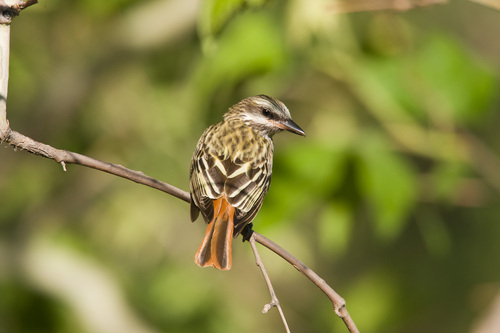
Sulphur-bellied Flycatcher
Myiodynastes luteiventris
The Sulphur-bellied Flycatcher is the 'squeaky toy' of the desert canyons, a boldly streaked hunter with a hidden flash of rusty-red in its tail. A master of the mid-air chase, this striking bird brings a tropical flair to the sycamore groves of the Southwest.
Quick Identification
Size
Length: 7.9-8.7 in (20-22 cm); Wingspan: ~14 in (35-36 cm); Weight: 1.4-1.8 oz (40-50 g)
Colors
Densely streaked brownish-black and white upperparts; pale sulphur-yellow belly with dark streaks; bright rufous (rusty-red) tail and rump; distinct dark eye mask and white eyebrow
Key Features
- Heavy dark streaking across the entire breast and back
- Bright rusty-red tail feathers visible in flight
- Bold black eye-line and white 'mustache' stripe
- Large, broad-based bill for catching large insects
When You’ll See Them
Behavior
The Sulphur-bellied Flycatcher is a boisterous and highly vocal bird, often heard before it is seen. Known for its distinctive call that sounds remarkably like a child's squeaky toy, it is a bold presence in the riparian canyons it calls home. Unlike many smaller flycatchers that hide in dense foliage, this species prefers to perch on prominent, exposed branches where it can keep a sharp eye out for passing insects or potential nest predators.
During the breeding season, they are fiercely territorial and will aggressively chase away much larger birds, including hawks and jays, from their nesting sites. They are cavity nesters—a unique trait among many flycatchers—and often select abandoned woodpecker holes in large sycamore trees. Their social interactions are characterized by frequent tail-flicking and loud, piercing whistles that echo through the canyon walls.
EverydayEarth exclusive
Camera Tips
To capture the Sulphur-bellied Flycatcher on camera, your best bet is to focus on their unique nesting requirements. In the American Southwest, they are almost exclusively tied to Arizona sycamores. If you have these trees on your property, mount your camera 10–15 feet high, angled toward natural cavities or abandoned woodpecker holes. Because they are cavity nesters, they return to the same specific spot repeatedly, providing excellent opportunities for consistent 'landing' shots.
Water is a massive draw for this species, especially in the dry heat of the afternoon. A backyard camera positioned near a solar-powered fountain or a 'dripping' birdbath can yield incredible footage. They prefer moving water over stagnant pools. Place the camera at eye level with the water source, about 4–6 feet away, ensuring the background is shaded to avoid overexposing the bird's pale yellow belly against the bright sun.
Since these birds are incredibly fast when 'sallying' for insects, use a camera with a high trigger speed (0.2 seconds or less). If your camera supports 'Burst Mode,' set it to take 3–5 photos per trigger to catch the moment they spread their wings, revealing the brilliant rufous tail feathers. Early morning light (the first two hours after sunrise) provides the best color accuracy for the subtle 'sulphur' wash on their underside.
Avoid using traditional birdseed 'bait,' as it won't interest them. Instead, focus on native landscaping. Planting berry-producing shrubs like elderberry or hackberry can attract them during the late summer months as they prepare for their southward migration. Position cameras near these fruiting branches during July and August for the best chance of capturing foraging behavior.
Similar Species
Species that look similar or are commonly confused with Sulphur-bellied Flycatcher.
Frequently Asked Questions
Record Sulphur-bellied Flycatcher at your habitat
Connect a camera to start building your own species record — AI identifies every visitor automatically.