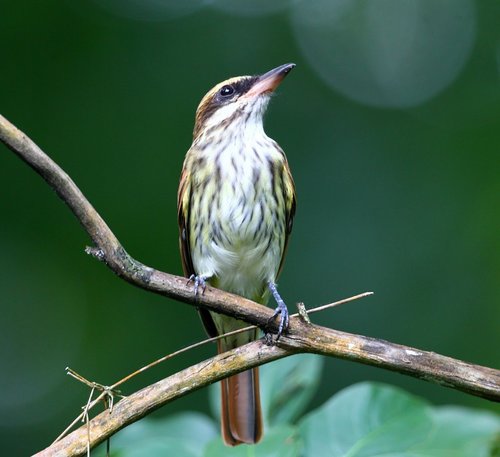
Streaked Flycatcher
Myiodynastes maculatus
A bold master of the aerial hunt, the Streaked Flycatcher is a vocal and charismatic visitor to backyards across the Americas. With its striking striped plumage and spirited personality, it is a favorite for birdwatchers looking to capture high-speed action on camera.
Quick Identification
Size
7.5 to 8.7 inches (19–22 cm) in length; wingspan of 12–14 inches (30–35 cm); weight approximately 1.4 to 1.8 oz (40–50 g).
Colors
Creamy white or pale yellow underparts with heavy dark brown vertical streaks; olive-brown upperparts with dark streaks; rufous-edged tail and wing feathers; dark eye mask.
Key Features
- Bold, vertical dark streaks across the chest and belly
- Heavy, hook-tipped black bill with a pale base
- Distinctive rufous (reddish-brown) edging on tail and wing feathers
- Prominent pale eyebrow stripe (supercilium) above a dark eye mask
When You’ll See Them
Behavior
The Streaked Flycatcher is a bold and conspicuous member of the tyrant flycatcher family, known for its vocal personality and 'sit-and-wait' hunting style. It is often seen perched high on exposed branches or telephone wires, where it scans the surrounding air for large insects. When prey is spotted, the bird performs an agile aerial maneuver known as a 'sally,' snatching the insect mid-air before returning to the same perch to consume its meal.
These birds are socially monogamous and highly territorial during the breeding season. They are not particularly shy around humans and have adapted well to modified landscapes, often making their presence known with a series of loud, squeaky calls that sound like a 'whe-chee' or 'sh-pwee.' While they are primarily insectivores, they are also quite social around fruiting trees, often joining mixed-species flocks to feed on berries and figs.
EverydayEarth exclusive
Camera Tips
To capture high-quality footage of a Streaked Flycatcher, you must understand their 'sentinel' behavior. These birds have favorite hunting perches—usually a dead limb or a high, unobstructed branch with a clear view of an open space. Identify these recurring spots and mount your AI camera at a distance of 10-15 feet, ideally angling it slightly upward. Because their 'sallying' flight is incredibly fast, use a camera with a high trigger speed and set it to take 3-5 image bursts to ensure you catch the moment of takeoff or landing.
While they won't visit traditional seed feeders, you can lure them into your camera's frame using water. A birdbath equipped with a solar-powered dripper or a small fountain is an irresistible draw for flycatchers, especially during the heat of the afternoon. Position your camera at eye level with the water source to capture the intricate details of their streaked plumage and the hidden yellow crown patch that is occasionally visible when they are excited or bathing.
During the fruiting season, move your cameras toward native trees like Ficus or palms. Streaked Flycatchers are frequent visitors to these 'buffets' and will spend more time stationary while feeding on berries than they do while hunting insects. This provides a golden opportunity for clear, sharp video. If you are using a trail camera, ensure the 'PIR' sensitivity is set to high, as these birds are medium-sized and may not always trigger lower-sensitivity sensors from a distance.
Placement in suburban environments can be particularly rewarding. These birds often nest in cavities, including holes in old trees or even the nooks of buildings. If you spot a pair investigating a cavity, set your camera 15 feet away with a clear line of sight to the entrance. Avoid placing the camera too close to the nest to prevent stressing the birds. Early morning light is the best for photography, as it highlights the warm rufous tones in their wings which can otherwise look dark and muted in heavy shade.
Similar Species
Species that look similar or are commonly confused with Streaked Flycatcher.
Sulphur-bellied Flycatcher
Has a much brighter yellow belly and a bolder, darker black stripe through the cheek area.
Piratic Flycatcher
Significantly smaller with a shorter bill and less rufous in the tail; known for 'pirating' the nests of other birds.
Variegated Flycatcher
Smaller and slimmer with a much smaller bill and a more distinct white collar effect on the neck.
Frequently Asked Questions
Record Streaked Flycatcher at your habitat
Connect a camera to start building your own species record — AI identifies every visitor automatically.