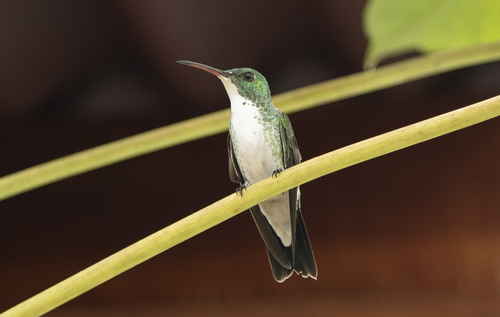
Plain-bellied Emerald
Chrysuronia leucogaster
A shimmering jewel of the coastal tropics, the Plain-bellied Emerald is easily recognized by its snowy white underside and feisty personality. Watch as this iridescent wonder transforms your garden into a high-speed aerial arena.
Quick Identification
Size
Length: 9–10 cm (3.5–4 in); Weight: 4–4.5 g (0.14–0.16 oz)
Colors
Metallic golden-green or bronze-green upperparts; brilliant, pure white throat and underparts; dark bronzy-green tail; bill is black with a pinkish-red base on the lower mandible.
Key Features
- Solid, pure white belly and throat
- Glistening golden-green crown and back
- Straight bill with a pinkish base
- Slightly notched bronzy-green tail
When You’ll See Them
Behavior
The Plain-bellied Emerald is an incredibly energetic and spirited hummingbird, often acting as the "boss" of the garden. Unlike many shy forest species, this emerald is quite bold and highly territorial. It spends much of its day patrolling a fixed route of flowering plants—a behavior known as 'trap-lining'—but it will fiercely defend a particularly rich nectar source from other hummingbirds and even large butterflies.
In your backyard, you’ll notice them for their erratic, darting flight patterns and their tendency to hover momentarily before zipping away at high speeds. They are solitary creatures, coming together only briefly for mating. When not feeding, they often find a high, exposed twig to perch on, where they preen their iridescent feathers and keep a watchful eye out for intruders or passing insects.
EverydayEarth exclusive
Camera Tips
To get the best shots of a Plain-bellied Emerald, placement is everything. Position your camera within 3 feet of a hummingbird feeder or a cluster of tubular flowers like Hibiscus or Ixora. These birds are small and move fast, so you need to minimize the distance to capture detail. Aim for a side-on angle to catch the contrast between the iridescent green back and the snowy white belly, which is their most defining feature. If possible, set your camera at a height of 4 to 5 feet, as they prefer to feed at mid-level shrub height.
Lighting is your best friend when dealing with iridescent feathers. Try to place your camera so the sun is behind you, illuminating the bird directly. This prevents the 'black silhouette' effect and allows the AI to pick up the golden-green shimmer on the crown. Avoid areas with heavy swaying foliage in the background, as the constant movement can trigger the camera unnecessarily, draining the battery and filling your storage with 'false positives' before the bird even arrives.
Because hummingbirds are incredibly fast, your camera settings need to be optimized for motion. Use a 'High' sensitivity setting for the PIR sensor and, if your hardware allows it, set the shutter speed to at least 1/1000s to freeze the wings. If you are recording video, 60fps is highly recommended; this allows you to play back the footage in slow motion, revealing the incredible wing mechanics that are invisible to the naked eye. Using a 'Pre-trigger' or 'Burst' mode is essential so you don't miss the bird as it enters and exits the frame in a split second.
Similar Species
Species that look similar or are commonly confused with Plain-bellied Emerald.
Frequently Asked Questions
Record Plain-bellied Emerald at your habitat
Connect a camera to start building your own species record — AI identifies every visitor automatically.