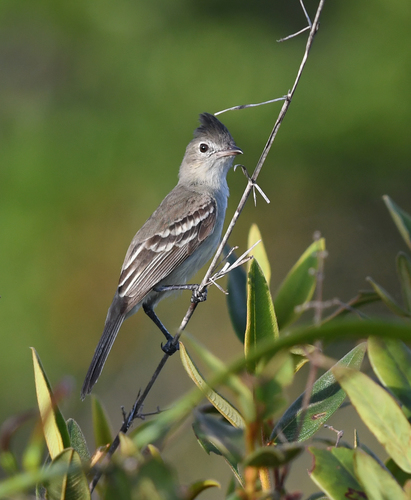
Plain-crested Elaenia
Elaenia cristata
With its iconic shaggy crest and energetic personality, the Plain-crested Elaenia is the undisputed spirit of the South American savanna. This small but bold flycatcher is a master of the 'perch and pounce,' bringing life to garden edges and open scrublands alike.
Quick Identification
Size
14–15 cm (5.5–6 in) long; weighs approximately 17–20 g (0.6–0.7 oz)
Colors
Olive-brown upperparts, grayish-white throat, and pale yellowish-white underparts; features two distinct white wing bars and a bushy crest.
Key Features
- Prominent shaggy crest often showing a concealed white patch
- Two bold white wing bars on dark wings
- Constant wing and tail flicking while perched
- Short, triangular bill with a pinkish base on the lower mandible
When You’ll See Them
Geographic range
Where Does the Plain-crested Elaenia Live?
The Plain-crested Elaenia is a widespread resident of South America, primarily inhabiting the tropical and subtropical regions east of the Andes. Its core population thrives in the vast Cerrado and Caatinga biomes of Brazil, extending northward into the Llanos of Venezuela and Colombia. It is also commonly found across the Guianas and reaches its southern limits in northern Bolivia and eastern Peru, showing a remarkable ability to adapt to human-altered landscapes as long as scrubby vegetation remains.
Basemap © OpenStreetMap contributors
Behavior
The Plain-crested Elaenia is an energetic and conspicuous member of the tyrant flycatcher family. It is best known for its restless nature, frequently perching on the outermost branches of shrubs where it performs a signature wing-flick and tail-pump. Unlike some of its more secretive relatives, this species often sits in the open, making it a favorite for backyard observers and photographers. It is highly territorial during the breeding season, often raising its shaggy crest into a sharp peak to signal dominance or excitement.
Socially, they are typically found in pairs or small family groups. They are vocal birds, especially at dawn when the males perform a "dawn song" consisting of raspy, burry whistles that carry surprisingly far across open landscapes. While they are primarily insect-eaters, they exhibit a high degree of social tolerance around fruiting trees, often joining mixed-species flocks to feast on seasonal berries.
EverydayEarth exclusive
Camera Tips
To capture the best footage of a Plain-crested Elaenia, position your camera near "sentinel perches." These birds love the very tip of a dead branch or a tall fence post that offers a 360-degree view of their territory. Mounting your camera at a height of 5 to 7 feet, angled slightly upward toward these prominent twigs, will give you the best chance of catching their dramatic crest-raising displays. Because they are fast-moving, ensure your camera is set to a high-trigger sensitivity to catch them before they sally off after an insect.
Feeding stations with traditional birdseed won't attract this species, but a shallow, elevated birdbath is an irresistible lure. They are meticulous bathers and will often visit the same water source daily during the heat of the afternoon. Placing the camera about 3 feet from a water feature with a stone landing pad will provide excellent close-up opportunities. Ensure the area has some nearby cover, as they feel safer with a quick escape route into a bush.
Lighting is crucial for this species; their olive and gray tones can look washed out in direct, harsh midday sun. Aim for a camera placement that catches the soft morning light. If you are using an AI-powered camera, the Plain-crested Elaenia is a great subject for learning to distinguish between flycatcher species—look for the "flicker" in the video feed, which is a behavioral giveaway that the AI can use to help verify the ID.
Similar Species
Species that look similar or are commonly confused with Plain-crested Elaenia.
Yellow-bellied Elaenia
Has much brighter yellow underparts and a more rounded head profile without the sharply peaked crest.
Lesser Elaenia
Smaller with a less prominent crest and a distinct, faster-paced vocalization.
Large Elaenia
Noticeably larger with a heavier bill and prefers more densely forested areas compared to the open-habitat Plain-crested.
Frequently Asked Questions
Record Plain-crested Elaenia at your habitat
Connect a camera to start building your own species record — AI identifies every visitor automatically.