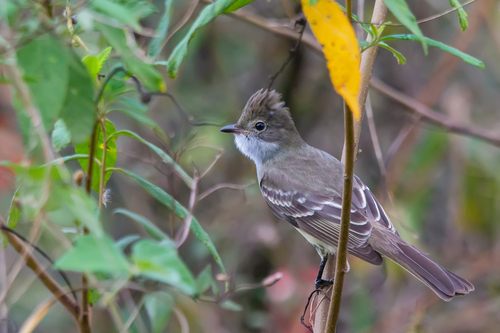
Large Elaenia
Elaenia spectabilis
A spirited and vocal inhabitant of South American woodlands, the Large Elaenia is a master of the canopy. Recognizable by its bushy crest and methodical hunting style, it is a delightful visitor to any backyard equipped with fruit trees and water.
Quick Identification
Size
17.5-19 cm (6.9-7.5 inches); 25-32 grams (0.88-1.13 ounces)
Colors
Dull olive-green or grayish-olive upperparts with two prominent whitish wing bars. The throat and breast are a pale, misty gray, transitioning into a soft pale yellow on the belly.
Key Features
- Bushy crest with a concealed white crown patch
- Two distinct pale wing bars on the wings
- Lacks a prominent white eye ring
- Relatively large and robust for the Elaenia genus
When You’ll See Them
Geographic range
Where Does the Large Elaenia Live?
The Large Elaenia is a native of the South American continent, primarily concentrated in the central and eastern regions. Its core territory spans across Brazil, Bolivia, and Paraguay, reaching down into northern Argentina and Uruguay. While resident in the more tropical parts of its range, southern populations are known to migrate northward toward the Amazon Basin, Colombia, and Peru during the cooler months, making them a seasonal highlight for birdwatchers in those regions.
Basemap © OpenStreetMap contributors
Behavior
The Large Elaenia is a quintessential member of the tyrant flycatcher family, known for its upright posture and alert demeanor. It spends much of its time perched on mid-level branches within the canopy, scanning the air for passing insects. Unlike some of its smaller, more frantic relatives, the Large Elaenia is somewhat more deliberate in its movements, though it is perfectly capable of sudden, acrobatic sallies to snatch prey from mid-air or pluck insects off the underside of leaves.
This species is notable for being more vocal and conspicuous than other elaenias, often announcing its presence with a characteristic burry or wheezing call. While they are generally solitary or found in pairs, they are not particularly shy of humans and are frequent visitors to suburban parks and gardens, especially those with mature trees. During the breeding season, they become highly territorial, aggressively chasing away other flycatchers that venture too close to their nesting sites.
EverydayEarth exclusive
Camera Tips
To capture high-quality footage of the Large Elaenia, camera placement is everything. Since these birds prefer the mid-to-upper canopy, you should mount your camera at a height of 2 to 4 meters, angled slightly upward toward a favorite perching branch. Look for 'staging branches'—exposed, horizontal twigs near fruiting trees or water sources where the bird might land to scan the area before feeding.
Unlike seed-eating birds, the Large Elaenia won't be attracted to traditional bird feeders. Instead, focus your camera on native fruiting shrubs or trees, such as those in the Melastomataceae family, which are a favorite food source. A birdbath or a misting water feature is also an excellent draw; these flycatchers are frequently seen bathing in shallow water or catching droplets in mid-air during the heat of the afternoon.
Because they are quick and often move between shade and sunlight, set your camera to a high shutter speed and use a 'burst' or 'multi-shot' mode to ensure you catch the moment they flare their bushy crest. If your camera allows for zone-based motion triggering, focus the trigger area on the perching branch rather than the foliage behind it to avoid false triggers caused by wind. Early morning light is best for highlighting the subtle olive and yellow tones of their plumage.
Similar Species
Species that look similar or are commonly confused with Large Elaenia.
Yellow-bellied Elaenia
Smaller in size with a much more prominent and complete white eye ring.
White-crested Elaenia
Displays its white crown patch more frequently and is significantly smaller with a thinner bill.
Mottle-backed Elaenia
Features distinct dark streaks or 'mottling' on its back, whereas the Large Elaenia has a more uniform olive-gray back.
Frequently Asked Questions
Record Large Elaenia at your habitat
Connect a camera to start building your own species record — AI identifies every visitor automatically.