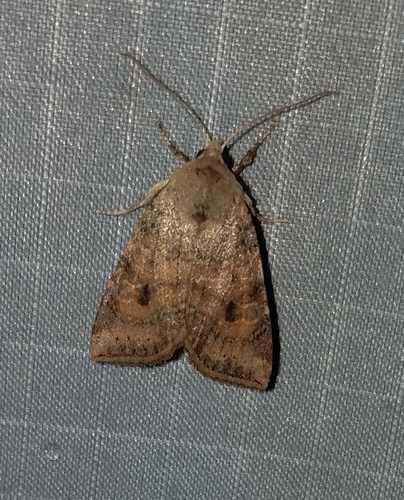
Poplar Catkin Sallow
Anathix puta
A delicate master of autumn camouflage, the Poplar Catkin Sallow is a late-season visitor to North American backyards. Look for this pale, straw-colored moth fluttering near willows and poplars as the nights begin to cool.
Quick Identification
Size
Wingspan of 23–29 mm (0.9–1.1 inches)
Colors
Pale straw-yellow to tan or grayish-brown forewings with darker outlines around the kidney-shaped reniform spot; hindwings are typically lighter or translucent white.
Key Features
- Pale straw or tan forewing coloration
- Distinct dark reniform (kidney-shaped) spot on the wing
- Wavy subterminal line across the outer wing area
- Small, slender build compared to other dart moths
When You’ll See Them
Geographic range
Where Does the Poplar Catkin Sallow Live?
The Poplar Catkin Sallow is native to the vast temperate regions of North America. Its primary range extends across the northern United States and throughout much of Canada, stretching from the Atlantic coast of Newfoundland all the way to British Columbia. In the United States, it is most frequently recorded in the Northeast, the Great Lakes region, and the Pacific Northwest, wherever its preferred host trees—poplars and willows—thrive in moist soils.
Basemap © OpenStreetMap contributors
Behavior
The Poplar Catkin Sallow is a nocturnal moth that emerges primarily in the late summer and early autumn. Unlike many flashier species, it relies on its subtle, leaf-like coloration to remain hidden against bark or dried foliage during the daylight hours. As a member of the Noctuidae family, it is a strong flyer, often drawn to light sources or fermenting organic matter once the sun sets.
In its larval stage, this species is a specialist, closely tied to the lifecycle of poplars and willows. The caterpillars hatch in early spring to coincide with the emergence of catkins (the flower clusters of these trees), which serve as their primary food source. This narrow window of feeding ensures the larvae grow quickly before the catkins drop, eventually moving to the ground to pupate in the soil.
For humans, the Poplar Catkin Sallow is a harmless and beneficial member of the ecosystem. While they aren't common household pests, they are frequent visitors to backyard gardens that feature their host trees. They play a role in the local food web, serving as a vital protein source for bats and late-season migratory birds preparing for their journey south.
EverydayEarth exclusive
Camera Tips
To capture the Poplar Catkin Sallow on your backyard camera, focus your efforts on the 'sugar-baiting' technique. Mix a concoction of overripe bananas, brown sugar, and a splash of beer or molasses, and paint it onto the trunk of a tree (ideally a poplar or willow) at eye level. Position your camera about 3 to 5 feet away from the bait. Because these moths are small, using a camera with a macro lens or a close-focusing capability is essential to see the fine details of their wing patterns.
Lighting is the most critical factor for nighttime insect photography. While standard infrared (IR) night vision on most trail cameras will capture the moth's presence, it will wash out the pale straw colors that define this species. If your setup allows, use a white-light flash or a specialized moth-camera rig with a low-intensity LED. This will highlight the subtle tan and yellow hues that distinguish the Poplar Catkin Sallow from other drab-colored 'dart' moths.
Timing is everything with this species. In most regions, you will only see them during the late summer and early fall transition. Set your camera to burst mode or short video clips (5-10 seconds) to capture them as they land and fan their wings. This fanning behavior is common when they first land on bait and provides the best opportunity for a clear identification shot of the forewing markings.
Finally, consider the height and angle of your camera. These moths often approach bait from below or the side. Angling your camera slightly upward or mounting it directly opposite the baited patch on a level plane will yield the best results. If you are using an AI-powered camera, ensure the 'small animal' or 'insect' sensitivity is turned up, as the movement of a single moth may not always trigger standard motion sensors designed for larger mammals.
Similar Species
Species that look similar or are commonly confused with Poplar Catkin Sallow.
Dusky Sallow
The Dusky Sallow is generally darker and more grayish-brown, lacking the bright straw-yellow tones of the Poplar Catkin Sallow.
Pale-banded Dart
The Pale-banded Dart has more contrasting dark and light bands across the wings, whereas the Poplar Catkin Sallow has a more uniform, pale coloration.
Frequently Asked Questions
Record Poplar Catkin Sallow at your habitat
Connect a camera to start building your own species record — AI identifies every visitor automatically.