Porcelain Berry
Ampelopsis glandulosa
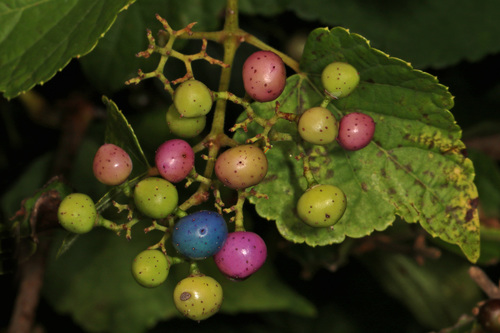
Adorned with clusters of jewel-toned berries in shades of turquoise and amethyst, Porcelain Berry is a striking but aggressive climber. It creates a vibrant late-season feast that attracts a wide variety of songbirds to your backyard.
Quick Identification
Size
A vigorous woody vine that can grow 15–25 feet (4.5–7.6 meters) long, with individual leaves spanning 2–5 inches (5–12 cm).
Colors
Deep green leaves; berries transition from pale green to shades of cream, lilac, turquoise, and vibrant cobalt blue.
Key Features
- Berries in multiple shades of blue and purple on the same cluster
- Heart-shaped, deeply lobed leaves with hairy veins underneath
- White pith inside the stems and smooth, non-shredding bark
- Small, inconspicuous greenish flowers that bloom in mid-summer
When You’ll See Them
Behavior
Porcelain Berry is a tenacious and opportunistic climber. Using its specialized twining tendrils, it quickly scales fences, trees, and shrubs to reach the sunlight. It is known for its incredible growth rate, which can easily overwhelm native vegetation in a single season. This vine doesn't just grow vertically; it creates a dense, multi-layered canopy that can block sunlight from reaching the plants beneath it, eventually killing the host plant.
While gardeners often view it as a nuisance or a beautiful but invasive guest, local wildlife treats it as a high-value supermarket. The plant focuses its energy on producing massive quantities of seeds encased in colorful berries to ensure its spread. Because it is highly adaptable, it can thrive in poor soil conditions and varying light levels, making it a permanent fixture in many suburban landscapes once it takes root.
EverydayEarth exclusive
Camera Tips
Since Porcelain Berry is stationary, the trick to great footage is treating the vine as a stage for the wildlife it attracts. Position your camera 3 to 6 feet away from a cluster of ripening berries. Because these vines often grow on fences or hang from trees, mounting your camera at a slight downward angle will help you capture birds as they land. Avoid pointing the camera directly into the sun; instead, try to have the sun at your back to illuminate the brilliant blues and purples of the berries, which can appear dull in deep shade.
Trigger sensitivity is crucial here. The birds attracted to Porcelain Berry, like Gray Catbirds and Northern Cardinals, are often flighty and move with quick, jerky motions. Set your camera to 'High' sensitivity and use a short trigger interval (or no delay) to ensure you don't miss the moment a bird plucks a berry. If your camera supports high-definition video, a 15-second clip is often better than a still photo, as it captures the struggle of the bird trying to balance on the thin, swaying tendrils of the vine.
Don't forget the 'night shift.' While the berries look best in daylight, many mammals like raccoons, opossums, and even foxes will visit the base of the vine at night to eat fallen fruit. If you want to see these visitors, place a second camera near the ground pointed at the base of the vine. Ensure the area is clear of tall grass that might trigger the sensor during a breeze, and use infrared mode to see the nocturnal foragers without startling them. Checking your camera lens weekly is also a must, as the dense foliage of the vine is a favorite spot for spiders to spin webs that can obscure your view.
Similar Species
Species that look similar or are commonly confused with Porcelain Berry.
Wild Grape
Grapes have bark that peels in strips and a brown pith inside the stem, whereas Porcelain Berry has smooth bark and a white pith.
Virginia Creeper
Virginia Creeper has five distinct leaflets and turns bright red in autumn, while Porcelain Berry has simple, lobed leaves and berries of many colors.
Frequently Asked Questions
Record Porcelain Berry at your habitat
Connect a camera to start building your own species record — AI identifies every visitor automatically.