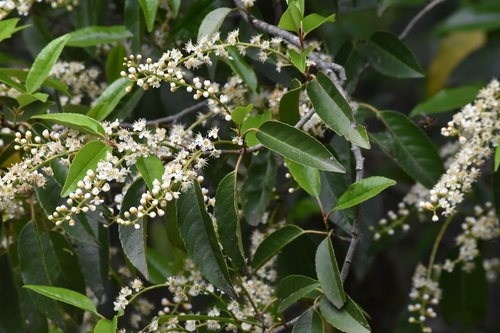
Portuguese laurel
Prunus lusitanica
A majestic evergreen with iconic red stems and glossy foliage, the Portuguese laurel is more than just a garden favorite—it's a thriving hub for backyard birds and pollinators.
Quick Identification
Size
Typically grows 3–15 metres (10–50 feet) tall with a spread of 5–10 metres (16–33 feet).
Colors
Deep glossy green leaves, vibrant reddish-pink stems (petioles), creamy white flowers, and dark purple to black berries.
Key Features
- Distinctive reddish-pink stems and twigs
- Glossy, dark green ovate leaves with serrated edges
- Small, fragrant white flowers in long racemes
- Small cherry-like fruits that turn from red to dark purple
- Smooth, dark grey bark that becomes fissured with age
When You’ll See Them
Geographic range
Where Does the Portuguese laurel Live?
Native to the Mediterranean region, the Portuguese laurel is primarily found across the Iberian Peninsula, including Portugal and Spain, as well as southwestern France and northern Morocco. It is also an important native component of the laurel forests in the Macaronesian archipelagos of Madeira, the Azores, and the Canary Islands. Due to its popularity in landscaping, naturalized populations have become well-established throughout the United Kingdom, Ireland, and the Pacific Northwest region of the United States and Canada.
Basemap © OpenStreetMap contributors
Behavior
Prunus lusitanica, commonly known as the Portuguese laurel, is a hardy evergreen shrub or small tree known for its elegant growth habit and year-round visual appeal. Unlike its cousin, the Cherry Laurel, it grows more slowly and maintains a tidier, more sophisticated shape naturally. It is a resilient species, capable of thriving in various soil types, though it prefers well-drained conditions and can tolerate both full sun and deep shade.
Biologically, the tree plays a vital role in its ecosystem by providing dense cover for nesting birds and a rich source of nectar for pollinators during the early summer months. In late summer and autumn, it produces a bounty of small fruits that, while bitter and inedible to humans, are a high-energy food source for various bird species. In garden settings, it is frequently used as a premium hedging plant due to its ability to withstand pruning and its striking contrast between green foliage and red stems.
EverydayEarth exclusive
Camera Tips
To capture the best activity around a Portuguese laurel, position your camera at a mid-level height (about 4-6 feet) directed toward a cluster of ripening berries or a flowering raceme. Because this tree is a magnet for songbirds like thrushes, waxwings, and blackcaps, a fast trigger speed is essential to catch them as they dart in for a snack. Avoid pointing the camera directly into the sun, as the glossy, waxy leaves of the laurel can cause significant glare and white-out your images on bright days.
During the flowering season in early summer, use a macro lens or a close-focus setting to capture the diverse array of pollinators, including honeybees and butterflies, that visit the fragrant white blooms. If your camera has a time-lapse mode, this species is an excellent subject for documenting the transition of its fruit from bright red to deep, glossy purple-black over several weeks in late summer.
For ground-dwelling wildlife, place a camera near the base of an established laurel hedge. The dense, evergreen canopy creates a protected corridor that small mammals like hedgehogs, squirrels, or foxes often use for transit or shelter. Since the foliage is very thick, ensure there is a clear line of sight to the subject area; a light pruning of small, obscuring twigs can prevent the infrared flash from bouncing back and overexposing your nighttime shots.
Similar Species
Species that look similar or are commonly confused with Portuguese laurel.
Frequently Asked Questions
Record Portuguese laurel at your habitat
Connect a camera to start building your own species record — AI identifies every visitor automatically.