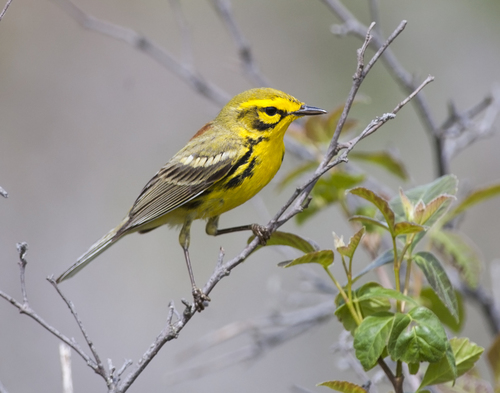
Prairie Warbler
Setophaga discolor
A vibrant yellow spark in the scrub, the Prairie Warbler is famous for its rhythmic tail-wagging and buzzy, ascending song. This active little bird is a master of early-successional habitats and a rewarding sight for any backyard observer.
Quick Identification
Size
Length: 4.3–5.1 in (11–13 cm); Wingspan: 6.3–7.5 in (16–19 cm); Weight: 0.2–0.4 oz (6–11 g)
Colors
Bright yellow underparts with bold black streaks on the flanks; olive-green back with chestnut-red patches; yellow face with a black crescent below the eye.
Key Features
- Distinctive black 'C' or crescent shape below each eye
- Rhythmic, persistent tail-wagging or bobbing
- Bright yellow throat and belly with black streaking on the sides
- Chestnut-colored streaks on an olive-green back
When You’ll See Them
Geographic range
Where Does the Prairie Warbler Live?
Native to the North American continent, the Prairie Warbler is a bird of the eastern United States and southeastern Canada. Its primary breeding range extends from the Gulf Coast states northward to southern Ontario, with significant populations concentrated in the Appalachian foothills and the Atlantic coastal plain. During the winter months, these birds migrate south to the Caribbean, southern Florida, and parts of Central America, where they are frequently found in mangrove forests and tropical scrub.
Basemap © OpenStreetMap contributors
Behavior
The Prairie Warbler is a high-energy songbird known for its constant movement. Unlike many other warblers that stay high in the canopy, this species prefers the mid-story and low shrubs of overgrown fields. Its most iconic behavior is a persistent, rhythmic wagging of the tail while perched or foraging, which makes it easier to spot even when it's partially hidden in dense foliage.
During the breeding season, males are persistent singers, delivering a buzzy, ascending series of notes that sound like a zipper being slowly pulled up. While they are generally solitary and territorial during the summer, they can be seen in loose 'mixed-species flocks' during migration, often traveling alongside Kinglets and other warbler species. They are not particularly shy around humans, often allowing for close observation if you remain still near their scrubby habitat.
EverydayEarth exclusive
Camera Tips
To capture the Prairie Warbler on your backyard AI camera, focus on water rather than food. Like most warblers, they rarely visit traditional seed feeders, but they are highly attracted to the sound and sight of moving water. Setting up a bird bath with a solar-powered dripper or a small fountain is the most effective way to lure them into your camera's field of view. Position the camera about 3 to 5 feet away from the water source to ensure the AI can trigger on their small, fast-moving frames.
Since Prairie Warblers are 'edge' specialists, place your camera near thickets, overgrown fence lines, or the transition zone between your lawn and taller trees. They prefer to stay within a few feet of cover. Avoid placing cameras in the middle of wide-open spaces or deep, shaded woods, as these birds thrive in the dappled sunlight of scrubby environments. Mount your camera at a height of 3 to 6 feet, angled slightly downward, to capture their low-level foraging and tail-wagging behavior.
Because these birds are incredibly fast and restless, camera settings are crucial. Use a 'High' sensitivity trigger and, if your camera allows, set it to record short video clips (10-15 seconds) rather than just stills. This increases your chances of capturing their distinctive tail-bob and ascending song. If your camera has a 'Pro' mode, a faster shutter speed is recommended to prevent motion blur from their constant hopping and wing-flicking.
Seasonal timing is everything for this species. In the northern parts of their range, ensure your cameras are active and well-charged during the spring migration 'push' in late April and May, and again during the fall migration in September. If you live in a coastal or southern region, keep a close watch during the winter months when they may frequent backyard shrubbery in search of late-season insects or small berries.
Similar Species
Species that look similar or are commonly confused with Prairie Warbler.
Palm Warbler
Palm Warblers also bob their tails but have a rusty-red cap and spend much more time foraging on the ground.
Pine Warbler
Pine Warblers lack the black facial crescent and side streaks; they are generally larger and prefer mature pine canopies over scrub.
Magnolia Warbler
Magnolia Warblers have a gray crown and a white wing bar, whereas Prairie Warblers have an olive-green back and yellowish wing bars.
Frequently Asked Questions
Record Prairie Warbler at your habitat
Connect a camera to start building your own species record — AI identifies every visitor automatically.