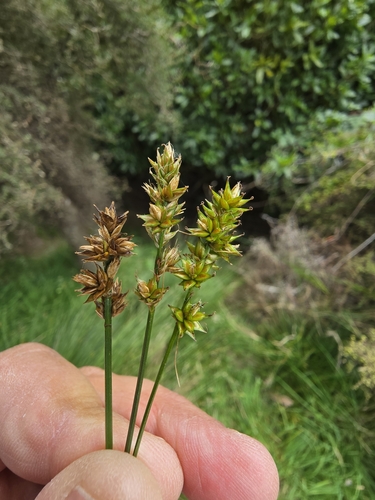
Prickly Sedge
Carex muricata
Meet the Prickly Sedge, the architectural gem of the backyard. With its star-shaped seed heads and vibrant green tufts, this hardy plant provides essential texture and habitat for your local ecosystem.
Quick Identification
Size
Grows in clumps 8-20 inches (20-50 cm) tall; leaf blades are 2-4 mm wide.
Colors
Bright green foliage; flower spikes are green-brown, turning golden-tan when mature.
Key Features
- Dense, tufted growth habit without runners
- Star-shaped, prickly-looking fruit clusters (perigynia)
- Sharply triangular stems that feel rough to the touch
- Tightly packed flower spikes at the top of the stalk
When You’ll See Them
Behavior
Prickly Sedge is a hardy, perennial plant that grows in characteristic dense tufts known as stools. Unlike many grasses that spread via underground runners, this sedge stays in neat, compact clumps, making it a well-behaved addition to garden borders and meadow edges. It is a wind-pollinated species, releasing its pollen in late spring when the air is dry enough for the grains to travel between plants.
In the backyard ecosystem, Prickly Sedge serves as an important structural element. It provides shelter for ground-dwelling insects and small amphibians who hide within the thick, arching foliage to escape predators or the midday sun. While it doesn't interact with humans in a traditional sense, its presence is a sign of a healthy, low-intervention landscape. It is particularly valued by gardeners for its ability to grow in the 'dry shade' found under large trees where other plants often fail.
EverydayEarth exclusive
Camera Tips
To capture the intricate beauty of Prickly Sedge, you need to think small and low. Place your camera on a ground-level stake or a mini-tripod no more than 6 to 12 inches off the ground. The most striking feature of this species is the 'prickly' star-shaped seed heads, so aim your lens horizontally or slightly upward to capture these clusters against a clear background. This 'worm's-eye view' will highlight the architectural quality of the stems and the texture of the fruit.
Since plants don't trigger motion sensors the way animals do, utilize your camera's time-lapse mode. Set the camera to take one photo every hour during the spring and summer months. When played back, this will create a stunning visual record of the plant 'waking up' in the spring, the rapid growth of the flowering stalks in May, and the eventual browning and seed dispersal in late summer. It is a fantastic way to document the phenology of your backyard habitat.
Pay close attention to lighting. Mid-day sun can create harsh shadows that hide the fine details of the triangular stems. For the best results, configure your camera to be most active during the 'golden hours' of shortly after sunrise or before sunset. The low-angle light will catch the edges of the seed heads and create a halo effect on the foliage. If your camera allows for macro focus, set it to focus on the top third of the plant where the flower spikes are located, as these are the primary diagnostic features for identification.
Similar Species
Species that look similar or are commonly confused with Prickly Sedge.
Spiked Sedge
Spiked Sedge (Carex spicata) has a purple-tinged base to its leaves and a distinct 'pith' inside the stem, unlike the more uniform green of the Prickly Sedge.
Grey Sedge
Grey Sedge (Carex divulsa) has much longer, more spread-out flower spikes and usually prefers deeper shade than Prickly Sedge.
Frequently Asked Questions
Record Prickly Sedge at your habitat
Connect a camera to start building your own species record — AI identifies every visitor automatically.