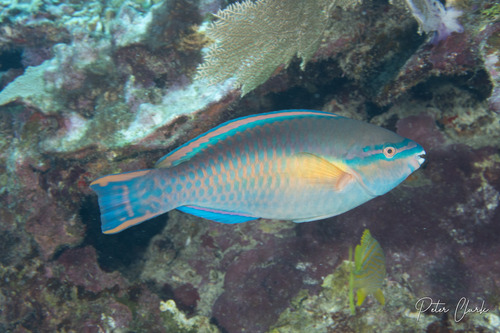
Princess Parrotfish
Scarus taeniopterus
The primary gardener of the Caribbean, the Princess Parrotfish is famous for its vibrant blue-green scales and its unique habit of sleeping in a protective mucus cocoon.
Quick Identification
Size
Typically 20–35 cm (8–14 inches) in length, weighing up to 1.5 kg (3.3 lbs).
Colors
Terminal males are blue-green with pinkish scale edges and a distinctive yellow stripe on the side; initial phase (females) are brown and white striped.
Key Features
- Two light horizontal stripes along the body in initial phase
- Fused beak-like teeth for scraping algae
- Yellowish patch or stripe near the pectoral fin
- Square-cut tail fin
When You’ll See Them
Sightings on EverydayEarth
Aug 1, 2026
A vibrant reef scene features several fish species navigating the current above the coral. A colorful terminal phase Princess Parrotfish swims prominently across the center of the frame. Nearby, a Stoplight Parrotfish moves through the water column, and multiple small, yellow Bluehead Wrasse are scattered throughout the scene, darting near the swaying sea fans.
Jul 26, 2026
A vibrant underwater scene shows several fish active on the reef. A Schoolmaster Snapper hovers near the base of a large sea fan at the bottom of the frame. A bright yellow Caribbean Bluehead Wrasse swims quickly past the purple sea fans, followed shortly after by a colorful Princess Parrotfish that traverses the frame from right to left.
Jun 16, 2026
The underwater reef is teeming with activity as various fish forage among the swaying sea fans. A terminal phase Bluehead Wrasse with its signature blue head and black collar swims across the upper-center of the frame. Below, several smaller yellow initial-phase wrasses dart between the corals. In the final seconds, a large Princess Parrotfish swims gracefully across the bottom foreground. A school of Sergeant Majors can be seen hovering in the blue water in the background.
Jun 8, 2026
A vibrant reef scene filled with activity. A large Princess Parrotfish swims gracefully across the frame, while several bright yellow Bluehead Wrasse and small Bicolor Damselfish dart among the purple sea fans. In the background, Blue Chromis hover in the clear blue water.
Jun 2, 2026
A vibrant underwater scene showing a Princess Parrotfish and an Atlantic Blue Tang swimming across a reef wall. Large sea fans and other gorgonians sway steadily in the current as several fish move through the coral environment.
May 19, 2026
A vibrant reef scene teeming with life. A large Princess Parrotfish swims gracefully through the upper water column, while schools of yellow Bluehead Wrasses and tiny Blue Chromis dart around the swaying sea fans and coral. Bicolor Damselfish can be seen hovering near the protection of the reef wall.
Geographic range
Where Does the Princess Parrotfish Live?
The Princess Parrotfish is a vibrant native of the Western Atlantic Ocean's tropical waters. Its core range radiates from the sun-drenched coasts of South Florida, the Bahamas, and Bermuda, extending south through the entire Caribbean basin. These colorful reef-dwellers are also commonly spotted along the Mesoamerican Barrier Reef and down the northern coast of South America toward Brazil.
Basemap © OpenStreetMap contributors
Behavior
The Princess Parrotfish is a diurnal grazer, spending its daylight hours patrolling coral reefs and sandy flats in search of food. They are often seen in small groups or mixed-species schools, moving with a characteristic 'rowing' motion using only their pectoral fins. Their presence is vital to the health of the reef, as they act as natural landscapers, keeping algae growth in check so that coral polyps can thrive.
As night falls, this species exhibits a fascinating survival strategy: it retreats into a crevice or under a ledge and secretes a transparent mucus cocoon around its body. This 'sleeping bag' is thought to mask the fish's scent from nocturnal predators like moray eels and may also provide an early warning system against parasites. They are generally approachable by divers and snorkelers but remain wary of sudden movements.
EverydayEarth exclusive
Camera Tips
For those lucky enough to have a backyard that opens onto a Caribbean reef or dock, capturing the Princess Parrotfish requires an underwater action camera (like a GoPro or Akaso) or a dedicated waterproof housing for your trail cam. Since these fish are most active during the day, position your camera in a shallow, sunlit area (3–8 meters deep) where algae-covered rocks or 'cleaning stations' are present. The best shots come from side-on angles that highlight the yellow side-stripe of the terminal male.
Lighting is your biggest challenge underwater. To avoid the 'blue wash' common in deep shots, try to keep your camera within 5 meters of the surface and ensure the sun is behind the lens. If you are using an AI-powered camera in a fixed underwater housing, aim it at a prominent coral head; Princess Parrotfish often return to the same grazing spots daily. Avoid using artificial lights or flashes during the day, as the natural shimmer of the scales provides the most authentic 'princess' glow.
While baiting isn't typically recommended for reef conservation, 'natural' baiting works best. You can encourage them to linger by placing the camera near a rock that has a fresh growth of green or turf algae. If you are setting up for a night shot to capture the mucus cocoon, use a very low-intensity red light to avoid waking the fish, as white light will cause them to break the cocoon and flee, leaving them vulnerable to predators.
Similar Species
Species that look similar or are commonly confused with Princess Parrotfish.
Frequently Asked Questions
Record Princess Parrotfish at your habitat
Connect a camera to start building your own species record — AI identifies every visitor automatically.