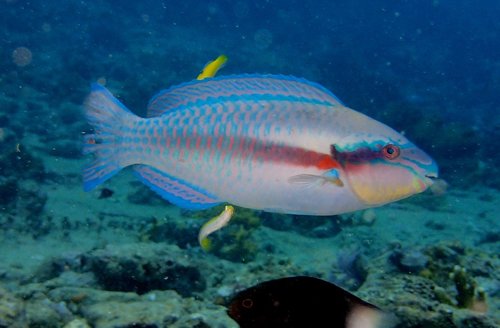
Striped Parrotfish
Scarus iseri
The Striped Parrotfish is a colorful Caribbean icon known for its unique 'beak' and its vital role in keeping coral reefs healthy by grazing on algae. From its striped juvenile phase to the neon brilliance of the terminal male, this species is a highlight for any underwater observer.
Quick Identification
Size
Typically 20–27 cm (8–11 in), reaching a maximum of 35 cm (14 in)
Colors
Initial phase: White or light yellow with two horizontal dark stripes; Terminal phase (males): Vibrant blue-green, pink, and yellow markings
Key Features
- Beak-like teeth fused into plates
- Two prominent horizontal dark stripes in initial phase
- Yellow blotch on the side of terminal phase males
- Square-shaped tail fin
When You’ll See Them
Geographic range
Where Does the Striped Parrotfish Live?
The Striped Parrotfish is native to the warm, tropical waters of the Western Atlantic Ocean. Its primary range spans from the southern tip of Florida and the Bahamas through the entire Caribbean Sea and the Gulf of Mexico. These fish are also found as far north as Bermuda and extend southward along the coast of Central America to the northern shores of South America, including Brazil. As a resident species, they do not migrate and can be found on their home reefs year-round.
Basemap © OpenStreetMap contributors
Behavior
Striped Parrotfish are industrious and highly social inhabitants of the reef. They are most commonly seen in large, roving schools that graze across the seabed. This schooling behavior offers protection from predators and allows them to efficiently cover large areas of the reef in search of food. They are diurnal, meaning they are active during the daylight hours and seek shelter in reef crevices as the sun sets.
One of the most fascinating behaviors of this species is their nighttime ritual. Like several of their relatives, Striped Parrotfish often secrete a transparent mucus cocoon around themselves before sleeping. This gelatinous bubble is thought to mask their scent from nocturnal predators, such as moray eels, and may also protect them from parasites. In terms of social structure, they are protogynous hermaphrodites, where dominant females can transition into colorful terminal-phase males when a vacancy occurs in the social hierarchy.
EverydayEarth exclusive
Camera Tips
Capturing the Striped Parrotfish requires an underwater housing or a specialized reef camera. For the best results, mount your camera near a 'cleaning station'—a specific spot on the reef where smaller fish like cleaner wrasses or gobies congregate. Striped Parrotfish frequently visit these stations and will remain stationary for several minutes, providing excellent opportunities for high-detail AI identification and photography.
Position the camera at a 45-degree angle to a patch of 'turf algae' on a rocky outcrop. This is their preferred feeding ground, and you can capture the unique way they use their beak-like teeth to scrape the surface. Because water absorbs red light quickly, ensure your camera is set to a shallow-water white balance mode or use a red filter if the camera is deeper than 3 meters to ensure the vibrant blues and yellows of the terminal phase males aren't washed out into a dull grey.
Sunlight is your best friend for underwater backyard cameras. Aim for the hours between 10 AM and 2 PM when the sun is directly overhead, as this provides the maximum illumination through the water column. Avoid using high-intensity artificial lights during the day, as the backscatter from floating particles can blur the image. Instead, rely on natural light to capture the iridescent scales of the fish as they swim through the frame.
In terms of settings, use a fast shutter speed (at least 1/200s) because parrotfish are constant movers. Their pectoral-fin swimming style involves quick, jerky movements that can easily result in motion blur. If your AI camera supports it, set a trigger zone around a prominent piece of coral where you see the fish frequently grazing to avoid capturing hours of empty blue water.
Similar Species
Species that look similar or are commonly confused with Striped Parrotfish.
Frequently Asked Questions
Record Striped Parrotfish at your habitat
Connect a camera to start building your own species record — AI identifies every visitor automatically.