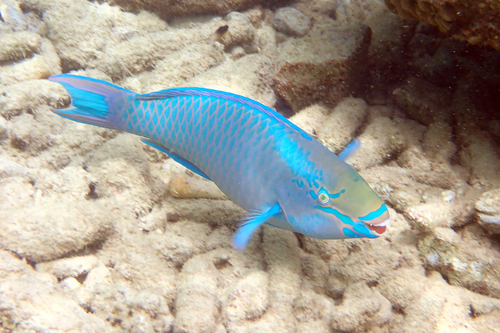
Queen Parrotfish
Scarus vetula
The Queen Parrotfish is the Caribbean's most colorful reef architect, famous for its vibrant blue scales and its ability to create white sand beaches through its unique diet.
Quick Identification
Size
Typically 30–50 cm (12–20 in) in length, reaching a maximum of about 61 cm (24 in); weight ranges from 1–3 kg (2–6.6 lbs).
Colors
Final phase (males) are vibrant blue-green with orange-pink accents and turquoise facial markings; initial phase (females) are reddish-brown with a distinct white horizontal stripe.
Key Features
- Fused parrot-like beak used for scraping algae
- Large, heavy scales with a metallic sheen
- Lunate (moon-shaped) tail in mature adults
- Broad blue and orange bands around the mouth and eyes
When You’ll See Them
Geographic range
Where Does the Queen Parrotfish Live?
Native to the tropical Western Atlantic Ocean, the Queen Parrotfish is a staple of Caribbean reef ecosystems. Its core range extends from the Florida Keys and the Bahamas through the entire Caribbean Sea and Gulf of Mexico, reaching as far north as Bermuda and as far south as the coast of Brazil. These fish are strictly marine residents and do not migrate, staying within the warm, sunlit waters of coral-rich environments where their food sources are abundant.
Basemap © OpenStreetMap contributors
Behavior
The Queen Parrotfish is a busy and social diurnal species that spends the vast majority of its daylight hours grazing on reef surfaces. They are sequential hermaphrodites, typically living in small harems where a single dominant terminal-phase male defends a territory containing several initial-phase females. If the male dies, the largest female in the group can undergo a biological transformation to become the new male.
At night, these fish exhibit a fascinating survival strategy: they find a crevice in the reef and secrete a transparent mucus cocoon from their mouths. This gelatinous bubble surrounds the fish and is thought to mask its scent from nocturnal predators like moray eels and sharks, while also acting as an early-warning system that vibrates if something touches it. They are generally curious but cautious around humans, often maintaining a 'safe distance' while continuing their grazing.
EverydayEarth exclusive
Camera Tips
Capturing high-quality footage of a Queen Parrotfish requires an underwater camera setup, such as a GoPro or a specialized AI-powered reef monitor. For the best results, mount your camera on a weighted tripod or a stable reef crevice near a 'cleaning station.' These are specific locations on the reef where parrotfish congregate to allow small cleaner wrasses to remove parasites from their skin. Because the fish remain relatively still during this process, it offers the perfect opportunity for your AI to lock focus and capture crisp detail.
Position your camera to face a sunlit patch of coral at a slight upward angle. This 'low-angle' approach allows the sunlight to catch the iridescent scales of the male's final phase, highlighting the neon blues and greens that can otherwise look dull at depth. Since parrotfish are most active during the day, ensure your camera is set to a high frame rate (60fps or higher) to account for their constant, jerky swimming motions as they move from one grazing spot to another.
If you are using a triggered camera, look for areas with fresh 'scrape marks' on the coral—these white, gouged lines are evidence of recent feeding and suggest the Queen Parrotfish will return soon. Avoid using bright artificial white lights during the day as they can spook the fish; instead, use a red filter to restore the warm colors lost underwater. For nocturnal shots, you might catch them in their mucus cocoons, but be extremely careful not to disturb their rest, as breaking the cocoon leaves them vulnerable to predators.
Similar Species
Species that look similar or are commonly confused with Queen Parrotfish.
Stoplight Parrotfish
The Stoplight male has a bright yellow spot near the upper gill cover and a yellow patch on the tail, whereas the Queen is more uniformly blue-green.
Princess Parrotfish
Smaller in size; the Princess Parrotfish has two blue-green stripes on its tail and lacks the 'queenly' facial markings.
Blue Parrotfish
Adult Blue Parrotfish are almost entirely blue with a distinct large bump on their forehead, unlike the Queen's flatter profile.
Frequently Asked Questions
Record Queen Parrotfish at your habitat
Connect a camera to start building your own species record — AI identifies every visitor automatically.