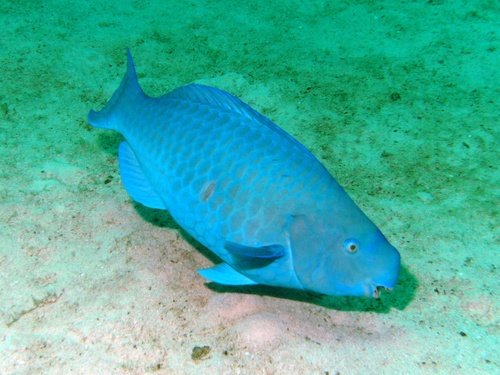
Blue Parrotfish
Scarus coeruleus
The Blue Parrotfish is the vibrant blue architect of the Caribbean, known for its bird-like beak and the incredible ability to turn coral into white sand beaches.
Quick Identification
Size
Typically 30 to 75 cm (12 to 30 inches); large males can reach up to 120 cm (47 inches)
Colors
Uniformly bright cyan or turquoise blue; juveniles often have a yellow spot on the top of the head
Key Features
- Parrot-like beak made of fused teeth
- Square, bulbous 'bump' on the forehead of adults
- Uniform blue color with no complex patterns
- Large, heavy cycloid scales
- Robust, oval-shaped body
When You’ll See Them
Geographic range
Where Does the Blue Parrotfish Live?
The Blue Parrotfish is a resident of the warm tropical and subtropical waters of the Western Atlantic Ocean and the Caribbean Sea. Its native range stretches from the coastal waters of Maryland in the United States, south through the Florida Keys and the Bahamas, and throughout the entire Caribbean basin down to the coast of Brazil. These fish are most concentrated in the clear, sun-drenched reef systems of the West Indies and the Gulf of Mexico.
Basemap © OpenStreetMap contributors
Behavior
The Blue Parrotfish is a highly social species, often seen roaming the reef in massive foraging groups that can exceed 500 individuals. This schooling behavior is a clever survival strategy; by moving in such large numbers, they can easily overwhelm territorial fish like damselfish and provide 'safety in numbers' against large predators like barracudas or reef sharks. During the day, they are tireless workers, constantly scraping algae from the reef surface to keep the coral ecosystem healthy and balanced.
When night falls, these fish exhibit a fascinating defense mechanism. They find a crevice in the reef and secrete a transparent, mucus-based 'sleeping bag' from their mouths. This cocoon completely envelops them, which scientists believe masks their scent from nocturnal hunters like moray eels and protects them from blood-sucking parasites. They remain dormant in this bubble until sunrise, when they break free to begin grazing again.
EverydayEarth exclusive
Camera Tips
Capturing the Blue Parrotfish on camera requires a waterproof setup, ideally a fixed underwater reef camera or an action camera mounted on a weighted tripod. If you have a backyard dock or a coastal property overlooking a shallow reef, place your camera in 10 to 15 feet of water. Position the lens to face a flat, algae-covered limestone ledge or a 'cleaning station' where small wrasses live. Parrotfish are creatures of habit and will frequent these specific spots daily to feed or have parasites removed from their scales.
Sunlight is your best friend when filming this species. To capture that iconic, electric-blue color, ensure your camera is positioned during the midday hours when the sun is directly overhead. This minimizes the 'blue wash' common in deeper water and highlights the vibrant cyan of their scales. If the water is murky, try to get the camera as close to the grazing surface as possible, as Parrotfish are surprisingly tolerant of stationary equipment once they realize it isn't a predator.
Set your camera to a high frame rate (60fps or higher) or use a fast shutter speed. Because they move their pectoral fins in a rapid, bird-like rowing motion and 'snap' at the coral with their beaks, standard frame rates can often result in motion blur. Since traditional bait isn't used for parrotfish, look for areas with 'turf algae'—the short, fuzzy green growth on dead coral—which acts as a natural lure that will bring them right in front of your lens.
Similar Species
Species that look similar or are commonly confused with Blue Parrotfish.
Queen Parrotfish
Look for a blue 'mustache' and more varied colors like green and pink, whereas the Blue Parrotfish is a solid, uniform cyan.
Midnight Parrotfish
The Midnight Parrotfish is a much darker navy blue with bright cyan spots on its scales, lacking the uniform light-blue color of the Blue Parrotfish.
Stoplight Parrotfish
Initial phase individuals are reddish-brown, and terminal males are green with a distinct yellow spot near the tail, unlike the all-blue Scarus coeruleus.
Frequently Asked Questions
Record Blue Parrotfish at your habitat
Connect a camera to start building your own species record — AI identifies every visitor automatically.