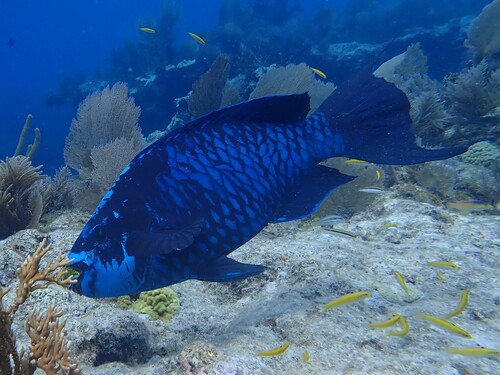
Midnight Parrotfish
Scarus coelestinus
The Midnight Parrotfish is the majestic 'gardener' of the Caribbean reefs, recognizable by its stunning electric-blue scales against a dark, night-sky body. These vital fish help keep our oceans healthy by grazing on algae and creating the white sandy beaches we love.
Quick Identification
Size
Typically 30 to 77 cm (12 to 30 inches) in length, weighing up to 7 kg (15 lbs)
Colors
Deep navy blue to near-black body with vibrant cyan or electric blue markings on the scales, fins, and beak; no significant color difference between sexes.
Key Features
- Distinctive bird-like beak for scraping algae
- Electric blue highlights on a dark midnight-blue body
- Large, heavy scales with bright blue edges
- Squared-off tail fin in adults
When You’ll See Them
Geographic range
Where Does the Midnight Parrotfish Live?
The Midnight Parrotfish is a native of the Western Atlantic Ocean, primarily concentrated in the warm tropical waters of the Caribbean Sea and the Bahamas. Its core range extends northward into the Florida Keys and south along the coast of Central America to the offshore reefs of Brazil. These fish are strictly marine and are most frequently found in high-energy reef environments where water clarity and coral health are at their peak.
Basemap © OpenStreetMap contributors
Behavior
The Midnight Parrotfish is a dedicated herbivore of the reef, spending the vast majority of its daylight hours grazing on algae. Using its powerful, beak-like teeth, it scrapes rocky substrates and dead coral, a process that is vital for the health of the reef ecosystem as it prevents algae from smothering coral polyps. These fish are often observed in small groups or mixed schools with other parrotfish species, moving gracefully across the reef flat.
As the sun sets, the Midnight Parrotfish seeks out a secure crevice or cave within the reef structure to rest. Unlike some other parrotfish, they don't always secrete a mucus cocoon, but they remain highly stationary and vulnerable during the night. In areas frequent by snorkelers and divers, they are generally curious but maintain a respectful distance, though they can become quite bold near established 'cleaning stations' where smaller fish remove parasites from their skin.
EverydayEarth exclusive
Camera Tips
Capturing the Midnight Parrotfish requires an underwater AI camera housing or a specialized reef-cam set at a depth of 5 to 15 meters. For the best results, position your camera near a 'cleaning station'—conspicuous coral mounds where small wrasses congregate. The Midnight Parrotfish will often hover nearly motionless in these spots for several minutes, providing the perfect opportunity for a high-resolution identification shot.
Because the deep blue and black colors of this species can easily blend into the background of the ocean, try to angle your camera so it captures the fish against a lighter sandy bottom or with the sun at your back. This lighting setup highlights the iridescent cyan markings on their scales which the AI uses for positive identification. If using a motion-trigger, set the sensitivity to high, as these fish move with a steady, rhythmic pulsing of their pectoral fins that may not always trigger low-sensitivity sensors.
For those with dock-mounted cameras in Florida or the Bahamas, the best time to catch a glimpse of these giants is during high tide when they move closer to shore to graze on submerged pilings. Ensure your camera lens is cleaned weekly of biofouling (algae growth) to maintain the clarity needed to distinguish the Midnight Parrotfish from the more common Blue Parrotfish.
Similar Species
Species that look similar or are commonly confused with Midnight Parrotfish.
Blue Parrotfish
Uniformly light blue body and a more pronounced 'hump' on the forehead in older adults.
Queen Parrotfish
Initial phase is mottled grey/brown; terminal phase males are bright green/blue with pink and orange markings, lacking the dark black base of the Midnight.
Stoplight Parrotfish
Features a distinct yellow spot near the gill cover and a yellow crescent on the tail fin.
Frequently Asked Questions
Record Midnight Parrotfish at your habitat
Connect a camera to start building your own species record — AI identifies every visitor automatically.