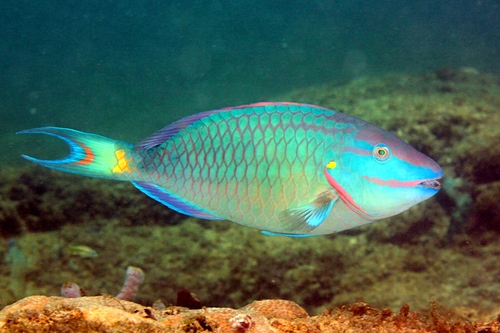
Stoplight Parrotfish
Sparisoma viride
The colorful architect of the Caribbean, the Stoplight Parrotfish is famous for its vibrant color shifts and its incredible ability to turn reef rock into white sand.
Quick Identification
Size
30–45 cm (12–18 in) on average, reaching a maximum length of 64 cm (25 in) and weighing up to 1.6 kg (3.5 lbs)
Colors
Terminal males are vibrant emerald green with a yellow spot on the gill cover; initial phase individuals (females/juveniles) are reddish-brown with white scales and a bright red belly
Key Features
- Beak-like teeth fused into plates
- Bright yellow spot on the upper gill cover and tail base in males
- Distinctive red underside in initial phase females
- Deeply forked or crescent-shaped tail in mature adults
When You’ll See Them
Sightings on EverydayEarth
Aug 1, 2026
A vibrant reef scene features several fish species navigating the current above the coral. A colorful terminal phase Princess Parrotfish swims prominently across the center of the frame. Nearby, a Stoplight Parrotfish moves through the water column, and multiple small, yellow Bluehead Wrasse are scattered throughout the scene, darting near the swaying sea fans.
Aug 1, 2026
A vibrant terminal phase Stoplight Parrotfish swims directly across the camera's field of view, revealing its colorful red and green scales. In the background, Blue Chromis and other small reef fish dart among swaying sea fans and coral outcroppings on the reef wall.
Jul 28, 2026
An initial phase Stoplight Parrotfish swims across the reef floor in the foreground, while several bright yellow Bluehead Wrasse and blue Atlantic Blue Tangs navigate the water column around large, swaying sea fans.
Jul 26, 2026
A busy scene on a Caribbean reef. Several yellow Bluehead Wrasses dart around large sea fans and coral heads, while a terminal phase male wrasse with its characteristic blue head and green body swims through the background. A Bicolor Damselfish is seen hovering near the central sea fan, and a larger Stoplight Parrotfish in its initial phase moves across the lower-left corner of the frame.
Jul 19, 2026
A vibrant and busy reef scene shows high biodiversity. Dozens of Caribbean Bluehead Wrasse dart between the coral heads, while a Western Atlantic Trumpetfish glides slowly across the top of the frame. An Atlantic Sergeant Major is visible near a large sea fan, and a school of French Grunts occupies the lower reef. In the background, Blue Chromis swim in the open water while a large Stoplight Parrotfish passes through.
Jul 18, 2026
A vibrant reef scene centered around a large sea fan. Several Blue Chromis and Caribbean Bluehead Wrasse are active in the water column, darting between the branches of the coral. An Atlantic Sergeant Major swims prominently near the top of the frame. Around twelve seconds into the footage, a large initial-phase Stoplight Parrotfish swims slowly across the foreground from left to right.
Geographic range
Where Does the Stoplight Parrotfish Live?
Native to the tropical and subtropical waters of the Western Atlantic Ocean, the Stoplight Parrotfish is a staple of Caribbean marine life. Its core range extends from the Florida Keys and Bermuda, through the Gulf of Mexico and the West Indies, and reaches as far south as the coastal reefs of Brazil. This species thrives in the warm, clear currents of the coral triangle and is rarely found in the cooler northern or southern latitudes.
Basemap © OpenStreetMap contributors
Behavior
The Stoplight Parrotfish is a highly active and essential member of the coral reef ecosystem. These fish are protogynous hermaphrodites, meaning they begin their lives as females and can eventually transition into terminal phase males. They spend their daylight hours patrolling the reef in a constant search for food, often seen traveling in small groups or as solitary individuals. They are relatively bold and often ignore divers, making them excellent subjects for underwater observation.
One of their most fascinating behaviors occurs at night. Like many parrotfish, they seek out crevices in the reef to sleep. Some individuals secrete a protective mucus cocoon that envelopes their body, which is thought to mask their scent from nocturnal predators like moray eels and sharks. During the day, they frequent 'cleaning stations' where smaller fish, such as cleaner wrasses, remove parasites from their skin and gills.
EverydayEarth exclusive
Camera Tips
Capturing the Stoplight Parrotfish requires an underwater camera setup, such as a GoPro or a specialized mirrorless camera in a waterproof housing. Since these fish are most active during the day, capitalize on natural sunlight between 10 AM and 2 PM when the sun is directly overhead. This provides the best penetration through the water column, bringing out the brilliant emerald greens of the terminal males and the deep reds of the females.
For the best results, position your camera near a 'cleaning station'—usually a prominent coral head where smaller wrasses gather. Parrotfish are creatures of habit and will return to these spots frequently. If you are using a stationary 'backyard' underwater camera near a dock or reef, aim the lens at a patch of reef with heavy algae growth. The Stoplight Parrotfish spends the majority of its day scraping these surfaces, providing ample opportunity for close-up shots of their unique beak-like teeth in action.
If you are looking for a unique night shot, look for crevices in the reef where a parrotfish might be 'parked' for the night. While their mucus cocoon is difficult to see, it creates a subtle shimmering effect under a dive light. Use a red light filter or a low-intensity focus light to avoid startling the fish, as sudden bright white light can cause them to bolt and damage themselves against the reef.
Similar Species
Species that look similar or are commonly confused with Stoplight Parrotfish.
Queen Parrotfish
Males lack the yellow gill spot and have blue 'mustache' markings around the mouth; females have a distinct horizontal white stripe.
Princess Parrotfish
Smaller in size; males have more pink/orange borders on their tail fins and lack the stoplight yellow spots.
Redband Parrotfish
Smaller with a white spot behind the dorsal fin and a characteristic red band from the eye to the mouth in males.
Frequently Asked Questions
Record Stoplight Parrotfish at your habitat
Connect a camera to start building your own species record — AI identifies every visitor automatically.