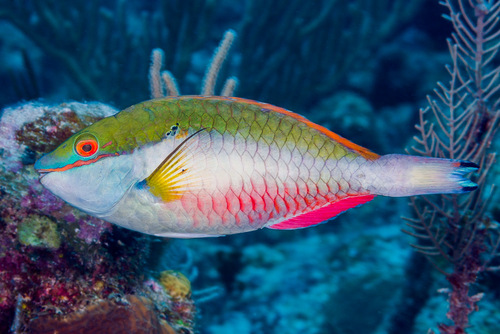
Redband Parrotfish
Sparisoma aurofrenatum
The Redband Parrotfish is the colorful gardener of the Caribbean, famous for its vibrant 'bridle' markings and its essential role in keeping coral reefs healthy by grazing on algae.
Quick Identification
Size
Typically 15 to 28 cm (6 to 11 inches), with a maximum length reaching approximately 30 cm (12 inches).
Colors
Terminal phase males are blue-green with a distinct orange-red band from the mouth to the eye; initial phase females are mottled reddish-brown with a white spot on the tail base.
Key Features
- Bright orange or red 'bridle' stripe from the corner of the mouth to the eye in males
- Small, distinct white spot located just behind the dorsal fin on the upper peduncle
- Beak-like teeth fused together for scraping algae
- Mottled reddish-brown body in females and juveniles
When You’ll See Them
Geographic range
Where Does the Redband Parrotfish Live?
The Redband Parrotfish is a vibrant resident of the Western Atlantic Ocean, primarily concentrated within the warm tropical waters of the Caribbean Sea. Its range extends northward to the coastal waters of Florida and the Bahamas, stretching south through the Greater and Lesser Antilles down to the coast of Brazil. While they are most abundant in the heart of the Caribbean, they are also frequently spotted along the Mesoamerican Barrier Reef spanning Mexico, Belize, and Honduras.
Basemap © OpenStreetMap contributors
Behavior
The Redband Parrotfish is a dedicated diurnal grazer, spending its daylight hours meticulously scraping algae from coral reefs and rocky substrates. They are often seen moving in a characteristic 'rowing' motion using their pectoral fins, a common trait among parrotfishes. While they are generally solitary compared to other parrotfish species, they are not strictly territorial and can be found sharing grazing patches with other herbivores.
One of their most fascinating behaviors occurs at night. Like several of its relatives, the Redband Parrotfish often secretes a transparent mucus cocoon around its body while sleeping in reef crevices. This envelope is thought to mask the fish's scent from nocturnal predators like moray eels and may also provide a barrier against parasitic isopods.
As protogynous hermaphrodites, these fish exhibit complex social structures where individuals can change sex from female to male. This transition is usually triggered by the absence of a dominant male in the local area, ensuring that the population always has a breeding terminal-phase male to lead the harem.
EverydayEarth exclusive
Camera Tips
Capturing the Redband Parrotfish on an AI-powered underwater camera requires strategic placement near 'cleaning stations' or high-algae coral heads. Unlike land animals, these fish respond well to stationary cameras mounted on weighted tripods or secured to dead coral structures (taking care not to damage living polyps). Aim your camera at a 45-degree angle toward the reef surface to capture the distinctive scraping behavior and the 'bridle' marking on the male's face.
Since these fish are most active during the day, ensure your camera is positioned to take advantage of natural sunlight. If you are using a camera in a 'backyard' dock or shallow reef area, the best footage is usually captured between 10 AM and 2 PM when the sun is directly overhead, providing the best color penetration for their blue and red hues. Using a red filter on your lens can help restore the warm tones that are lost as light travels through water.
For truly unique footage, configure your camera for night-time 'time-lapse' photography in a reef crevice. If you are lucky, you can capture the process of the fish secreting its protective mucus cocoon. While most trail cameras use infrared (IR) for night shots, which is invisible to most fish, ensure the unit is well-camouflaged; the Redband Parrotfish is curious but can be spooked by large, shiny metallic objects appearing in its sleeping quarters.
Lastly, pay attention to the surge and current. Secure your equipment with extra weight or marine-grade tethers. A shaky camera will struggle with AI identification. Set your trigger sensitivity high, as the rapid, jerky swimming motion of parrotfish can sometimes be missed by slower sensors. High-frame-rate settings are recommended to capture the detail in their fast-moving pectoral fins.
Similar Species
Species that look similar or are commonly confused with Redband Parrotfish.
Stoplight Parrotfish
Stoplight males have a bright yellow spot on the gill cover and tail base, lacking the Redband's mouth-to-eye stripe.
Queen Parrotfish
Queens are significantly larger with a distinct blue 'mustache' and 'eyebrow' pattern not found on Redbands.
Princess Parrotfish
Princess Parrotfish have two blue/green stripes on the tail and lack the Redband's specific white spot behind the dorsal fin.
Frequently Asked Questions
Record Redband Parrotfish at your habitat
Connect a camera to start building your own species record — AI identifies every visitor automatically.