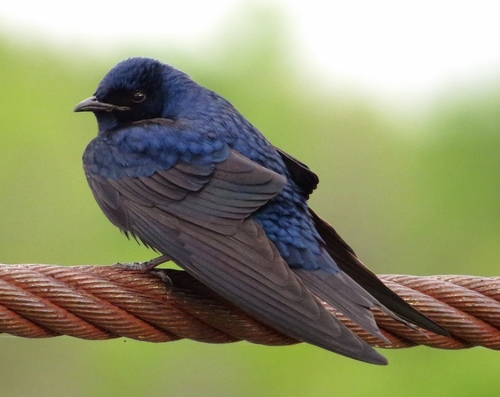
Purple Martin
Progne subis
The largest swallow in North America, the Purple Martin is a master of the air and a beloved backyard guest. Known for their shimmering iridescent feathers and social colonies, these birds offer a spectacular display of aerial agility and vocal charm.
Quick Identification
Size
Length: 19-20 cm (7.5-8 in), Wingspan: 38-41 cm (15-16 in), Weight: 45-60 g (1.6-2.1 oz)
Colors
Adult males are an iridescent dark blue-purple that can look black or green in low light. Females and juveniles are duller with gray or brownish breasts and white bellies.
Key Features
- Largest North American swallow
- Iridescent dark purple-blue plumage in males
- Broad, triangular wings and slightly forked tail
- Human-dependent colonial nester in the East
When You’ll See Them
Geographic range
Where Does the Purple Martin Live?
Native to the Americas, the Purple Martin has a vast migratory range that spans from the temperate regions of North America down to the tropical heart of South America. During the breeding season, they are common throughout the eastern United States and parts of southern Canada, with smaller, localized populations found along the Pacific Coast and in the high deserts of the Southwest. As autumn approaches, these resilient travelers fly thousands of miles to winter in countries like Brazil, Bolivia, and Colombia, making them a true cross-continental species that thrives in both suburban and wild landscapes.
Basemap © OpenStreetMap contributors
Behavior
Purple Martins are highly social aerial acrobats that spend most of their daylight hours on the wing. They are famous for their colonial nesting habits, particularly in eastern North America, where they have become almost entirely dependent on human-provided housing like gourds and multi-room birdhouses. Their flight is characterized by a mix of rapid flapping and graceful gliding, often accompanied by cheerful, gurgling vocalizations and liquid chirps.
In the wild, they are fascinating to watch as they hunt in large groups, often flying high in the sky to catch insects. They are exceptionally clean birds, and both parents work tirelessly to feed their brood. During the late summer, they gather in massive pre-migratory roosts numbering in the hundreds of thousands, often under bridges or in reed beds, before embarking on their long journey to South America.
EverydayEarth exclusive
Camera Tips
To capture the best footage of Purple Martins, position your AI camera with a clear, unobstructed view of their nesting entrance. Since these birds are colonial nesters, focusing on the landing porches of a martin house or the openings of nesting gourds is the most effective strategy. Aim for a mounting height of 10 to 15 feet to match the elevation of their housing, and ensure the lens is angled slightly upward to catch them as they descend for a landing. Side-lighting from the early morning or late afternoon sun is ideal, as it highlights the iridescent sheen of the male's plumage without causing harsh silhouettes.
Unlike many backyard birds, you cannot lure Purple Martins with seed or suet feeders, as they only eat flying insects. However, you can increase your camera's activity by providing 'social lures.' Martins are highly attracted to the sounds and sights of their own kind; playing recorded 'dawn songs' or placing realistic decoys on the housing can bring them closer to your lens. A nearby birdbath or a misting station can also be a magnet for these birds on hot summer days, providing a unique angle for action shots of them drinking or bathing on the wing.
Timing is critical for successful monitoring. Set your camera to be most active from dawn until mid-morning when the males are most vocal and territorial. During the nesting season (May through July), you'll capture the highest volume of activity as parents make hundreds of trips per day to bring food to their chicks. High-speed shutter settings are recommended to freeze their fast-moving wings, and ensure your camera's trigger sensitivity is high, as martins approach their nests at significant speeds that can outpace slower sensors.
Similar Species
Species that look similar or are commonly confused with Purple Martin.
Frequently Asked Questions
Record Purple Martin at your habitat
Connect a camera to start building your own species record — AI identifies every visitor automatically.