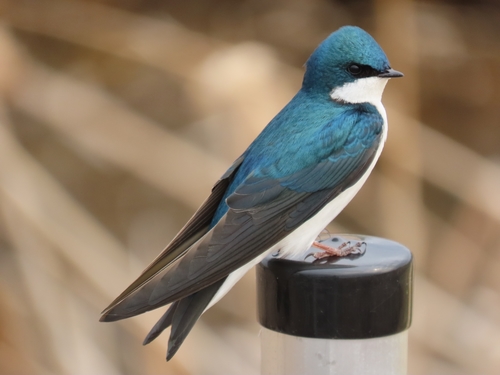
Tree Swallow
Tachycineta bicolor
A shimmering jewel of the sky, the Tree Swallow is a welcome guest in any backyard, known for its iridescent blue plumage and spectacular aerial maneuvers.
Quick Identification
Size
Length 12–15 cm (4.7–5.9 in), wingspan 30–35 cm (11.8–13.8 in), weight 16–25 g (0.6–0.9 oz)
Colors
Iridescent blue-green upperparts (males), pure white throat and underparts, blackish-brown wings and tail; females are slightly duller with first-year females appearing mostly brown
Key Features
- Glossy blue-green iridescent back
- Clean white underparts from chin to vent
- Shallowly forked tail and broad, triangular wings
- Small black bill and dark brown eyes
When You’ll See Them
Sightings on EverydayEarth
May 28, 2026
Several Tree Swallows are active around the Osprey nest at sunrise. They are seen swooping through the air and landing on the nest's wooden sticks and metal frame. One swallow perches prominently on the right side of the nest while others fly past.
May 24, 2026
A Tree Swallow is perched on the wire rim of an elevated nesting platform. It remains alert, frequently turning its head to scan the surrounding wetland and mountains before briefly grooming its feathers.
May 18, 2026
Several Tree Swallows are active around a wooden perch overlooking a marsh. The birds are seen landing, taking off, and perching, with their iridescent plumage catching the early morning sunlight. Their bright white underparts are clearly visible as they bank in flight.
Geographic range
Where Does the Tree Swallow Live?
Native to the vast landscapes of North America, the Tree Swallow is a true long-distance traveler that spends its summers breeding across the United States and Canada. As the seasons shift, these birds undertake an impressive migration to warmer climates, settling along the southern US coasts, Mexico, and deep into Central America as far as Panama. They are also common winter residents in the West Indies, often found gathering in massive, swirling flocks near coastal wetlands and marshes.
Basemap © OpenStreetMap contributors
Behavior
Tree Swallows are masterful aerial acrobats, spending the vast majority of their daylight hours on the wing. They are famous for their social nature, often nesting in loose colonies and gathering in massive, swirling clouds numbering in the hundreds of thousands during migration. These displays, known as roosting swarms, are one of nature's great spectacles, often occurring over reed beds at sunset.
In the backyard, they are vocal and territorial during the nesting season but generally tolerant of human presence. They are highly attracted to open spaces near water where they can forage for insects mid-air. Unlike many other swallows, they are cavity nesters, which makes them one of the most successful species to occupy man-made birdhouses.
EverydayEarth exclusive
Camera Tips
To capture the best footage of Tree Swallows, your best bet is to mount an AI-powered camera specifically focused on a nest box entrance. Position the camera roughly 1 to 2 feet away from the hole, angled slightly from the side to capture both the bird's iridescent blue back and its white belly as it enters and exits. Because Tree Swallows are incredibly fast, ensure your camera is set to its highest frame rate (at least 30-60 FPS) to avoid motion blur during their rapid fly-bys.
Timing is everything with these birds. They are most active during the early morning hours when insects begin to hatch over nearby water. If you are using a trail camera in an open field, look for a 'perching post'—a lone branch or a fence wire near a water source. Swallows often return to the same spot to rest between foraging bouts. Setting your camera's PIR sensor to high sensitivity is recommended, as their small body size and high speed can sometimes fail to trigger sluggish sensors.
Consider the lighting carefully; to truly capture the metallic sheen of their feathers, aim for a spot that gets direct morning or late afternoon sun. In the winter, if you live in a coastal southern region, you can find them near bayberry bushes. Placing a camera near these food sources during a cold snap can provide rare footage of their berry-eating behavior, which is unique among North American swallows.
Similar Species
Species that look similar or are commonly confused with Tree Swallow.
Violet-green Swallow
Look for white patches that wrap further around the eye and onto the sides of the rump, which the Tree Swallow lacks.
Barn Swallow
Easily distinguished by its deeply forked 'streamer' tail and rufous-orange belly compared to the Tree Swallow's pure white underside.
Purple Martin
Much larger than a Tree Swallow; males are entirely dark purple/black without the stark white underparts.
Frequently Asked Questions
Record Tree Swallow at your habitat
Connect a camera to start building your own species record — AI identifies every visitor automatically.