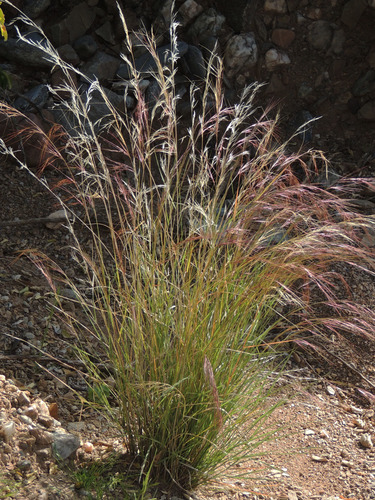
Purple Threeawn
Aristida purpurea
A shimmering jewel of the dry prairie, Purple Threeawn transforms backyards into a sea of swaying burgundy. Its iconic three-pronged seeds catch the sun, providing both dramatic beauty and essential habitat for small wildlife.
Quick Identification
Size
Height: 30-75 cm (12-30 inches); Spread: 15-45 cm (6-18 inches)
Colors
Reddish-purple to burgundy seed heads; grayish-green foliage turning straw-colored in winter
Key Features
- Three distinct long awns branching from each seed
- Purplish-red seed heads that shimmer in sunlight
- Dense, tufted 'bunchgrass' growth habit
- Extremely narrow, rolled leaf blades
When You’ll See Them
Behavior
Purple Threeawn is a perennial bunchgrass that plays a vital role in the early stages of prairie recovery and soil stabilization. Unlike many turf grasses, it grows in distinct, tight clumps, leaving space between plants for wildflowers and wildlife to navigate. It is known for its 'dancing' movement in the wind, which is amplified by the long, hair-like awns that give the species its name.
As the plant matures, its behavior is centered on seed dispersal. The three awns act as a sophisticated delivery system; they are sensitive to humidity and can twist or untwist, effectively 'drilling' the seed into the soil or hitching a ride on the fur of passing animals. While not a primary food source for large livestock due to its sharp seeds, it provides critical structural complexity in dry ecosystems.
EverydayEarth exclusive
Camera Tips
Capturing the beauty of Purple Threeawn on a backyard or trail camera requires a focus on lighting rather than movement. To truly highlight the 'purple' in its name, position your camera to the west of the plant, facing east. This creates backlighting during the 'golden hour' of late afternoon, which causes the translucent awns to glow with a brilliant reddish-purple hue. Without this specific lighting, the grass can appear as a muted brown or gray on camera.
Because this species is highly reactive to the wind, it is a frequent cause of 'false triggers' on PIR (Passive Infrared) motion sensors. If you are using a camera to monitor the plant itself, set your sensitivity to 'Low' or use a 'Time Lapse' mode rather than motion detection. However, if you are using the grass as a backdrop for wildlife, utilize the 'Zone' setting on your camera to exclude the moving seed heads from the trigger area while keeping the ground beneath it active.
For those interested in the 'micro-wildlife' that visits the grass, mount your camera on a low stake just 6-10 inches off the ground. Purple Threeawn is a magnet for small lizards and ground-feeding birds like sparrows, who use the dense base for cover. Using a 'Macro' lens or a camera with a close focal distance (within 3-5 feet) will allow you to see the incredible detail of the three-pronged seeds, which are often missed by the naked eye.
In the winter months, don't move your camera! While the purple color fades to a golden-straw hue, the structure of the grass becomes even more important for wildlife. Use a high-shutter speed setting during winter storms to capture the dramatic way this grass captures frost and snow, creating high-contrast images that look like natural sculptures.
Similar Species
Species that look similar or are commonly confused with Purple Threeawn.
Frequently Asked Questions
Record Purple Threeawn at your habitat
Connect a camera to start building your own species record — AI identifies every visitor automatically.