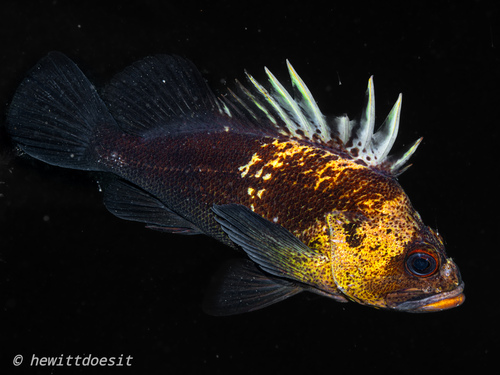
Quillback Rockfish
Sebastes maliger
A master of camouflage with a crown of venomous spines, the Quillback Rockfish is a stunning find for any underwater explorer. These long-lived reef dwellers are the solitary sentinels of the Pacific's rocky depths.
Quick Identification
Size
Typically 30-45 cm (12-18 inches), but can reach up to 1 m (39 inches) in length; weighs 0.9-3.2 kg (2-7 lbs).
Colors
Mottled orange-brown to brownish-black body with high-contrast yellow or cream-colored patches on the back and dorsal fin; fins are generally darker than the body.
Key Features
- Extremely high, sharp dorsal spines with deep notches in the membrane
- Distinctive mottled orange and brown camouflage pattern
- Large, rounded pectoral fins and a stocky, deep-bodied profile
When You’ll See Them
Behavior
Quillback Rockfish are the quintessential homebodies of the Pacific reefs. As a solitary and non-migratory species, an individual Quillback will often spend its entire adult life within a very small area of a single rocky outcrop or kelp forest. They are rarely seen in schools, preferring to hover silently near the seafloor or wedge themselves into protective crevices to avoid predators. While they are not aggressively territorial, their high site fidelity means that the same fish can often be spotted in the exact same location year after year.
These fish are viviparous, meaning they give birth to live, free-swimming larvae rather than laying eggs, a rarity among fish species. Despite their somewhat sluggish appearance, they are highly efficient ambush predators. Humans should handle them with extreme caution; those namesake "quills" on their back are tipped with venom that can cause significant pain and swelling if they puncture the skin.
EverydayEarth exclusive
Camera Tips
To capture high-quality footage of a Quillback Rockfish, you’ll need specialized underwater equipment, as these fish rarely venture into shallow tide pools. A weighted "drop-cam" or a stationary underwater housing mounted to a pier piling or a weighted reef-base is ideal. Because the Quillback’s habitat is often dark, look for a camera with high-lumen, diffused LED lighting. Avoid harsh, direct beams which can cause a "hot spot" on the fish’s reflective scales and trigger the AI to misidentify the species as a generic flash of light.
Position your camera near high-relief structures—specifically areas with deep cracks, caves, or large boulders. Quillbacks are curious but cautious; they are more likely to approach a camera that has been stationary for several hours. Since they are relatively slow-moving and tend to hover in place, set your camera to record short video clips (15-30 seconds) rather than high-speed bursts. For AI-powered detection, a side-profile view is best, as it allows the software to clearly recognize the unique notched shape of the dorsal fin and the specific mottled color patterns that distinguish them from other rockfish.
If your local regulations allow, you can use a "scent lure" to bring these solitary fish into view. A small, perforated container filled with crushed crab or fish trimmings secured about two feet in front of the lens is highly effective. This draws the Quillback out of its crevice without the fish being able to eat the bait and leave immediately. Early morning light often provides the best clarity in coastal waters, especially during a slack tide when there is less silt and debris moving through the water column.
Lastly, consider the seasonal visibility of your water. In many regions, winter and early spring offer the clearest underwater visibility due to lower plankton counts. While Quillbacks are present year-round, filming during these clear-water windows will significantly improve the success rate of your AI identification and provide much crisper, high-definition captures of their intricate orange and brown markings.
Similar Species
Species that look similar or are commonly confused with Quillback Rockfish.
Copper Rockfish
Lacks the high, deeply notched dorsal spines of the Quillback and has a more uniform copper-brown color.
Yelloweye Rockfish
Much larger with bright yellow eyes and a more brilliant, solid orange-red color compared to the Quillback's mottled brown.
China Rockfish
Easily distinguished by a bold, bright yellow stripe that runs along its dark blue-black body.
Frequently Asked Questions
Record Quillback Rockfish at your habitat
Connect a camera to start building your own species record — AI identifies every visitor automatically.