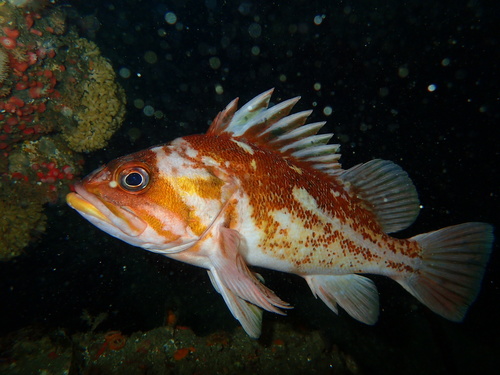
Copper Rockfish
Sebastes caurinus
The patient sentinel of the Pacific reefs, the Copper Rockfish is a master of camouflage and a long-lived resident of our coastal waters. With its shimmering metallic scales and deep-seated territorial instincts, it is one of the most rewarding species to discover on an underwater backyard camera.
Quick Identification
Size
Typically 12-20 inches (30-50 cm) long, reaching a maximum of 26 inches (66 cm) and up to 10 lbs (4.5 kg)
Colors
Varied shades of copper-brown, orange, and maroon with a distinct whitish or pale-pinkish stripe along the rear half of the lateral line and a clear white belly.
Key Features
- Broad, heavy-bodied profile
- Clear white or pale stripe along the posterior lateral line
- Two or three dark bands radiating from the eye
- Deeply notched dorsal fin with 13 spines
When You’ll See Them
Geographic range
Where Does the Copper Rockfish Live?
Native to the coastal waters of the eastern Pacific Ocean, the Copper Rockfish thrives in temperate marine environments. Its core range extends from the northern Gulf of Alaska down through the Salish Sea and along the Pacific coastline to the central Baja California peninsula. These fish are particularly abundant in the rocky inlets and fjords of British Columbia and the Puget Sound, where they inhabit depths ranging from the shallow intertidal zone down to nearly 200 meters.
Basemap © OpenStreetMap contributors
Behavior
Copper Rockfish are classic 'homebodies' of the reef. Unlike some wider-ranging marine species, these fish are highly territorial and exhibit extreme site fidelity, often spending their entire adult lives within a small area of just a few square meters. They are primarily solitary hunters, though they can occasionally be found in loose aggregations near high-quality cover like kelp forests or complex rocky outcroppings.
As ambush predators, their behavior is characterized by patience. They spend much of the day resting on the sea floor or hovering motionless just above the substrate, waiting for prey to drift or swim within striking distance. While they are generally wary of large disturbances, they are curious enough to be frequently spotted by divers and underwater trail cameras, often staring directly into the lens with their large, expressive eyes.
EverydayEarth exclusive
Camera Tips
Capturing the Copper Rockfish requires a specialized underwater camera setup, such as a GoPro with an external battery pack or a permanent PoE (Power over Ethernet) underwater camera. Because these fish are highly territorial and reside in 'backyard' marine environments like private docks or rocky shorelines, consistency is key. Place your camera near a known crevice or rock pile where the fish can hide; they are most likely to pose for the camera when they feel secure in their immediate surroundings.
Lighting is the biggest challenge when filming rockfish. At depths beyond 10 meters, the red spectrum of light is lost, making the fish appear grey or dull green. Use a dual-light setup with wide-angle video lights (at least 2000 lumens) to bring out the vibrant copper and orange hues. Set your camera to a wide-angle view to capture the surrounding kelp or reef, which provides context for their habitat.
To attract Copper Rockfish to your lens, you don't necessarily need bait, as they are naturally curious. However, placing the camera near an area with high barnacle or mussel growth often attracts the smaller crustaceans they feed on, naturally bringing the rockfish into frame. If using a baited canister, ensure it is securely weighted to the bottom and positioned about 3 to 5 feet from the lens to allow for proper focal distance and to prevent the fish from bumping the camera.
Similar Species
Species that look similar or are commonly confused with Copper Rockfish.
Quillback Rockfish
Has much longer, sharp dorsal spines and a more mottled, yellowish-brown appearance without the distinct white lateral stripe.
Brown Rockfish
Identified by a prominent dark spot on the gill cover (operculum) and lacks the bright copper-white contrast of the Copper Rockfish.
Gopher Rockfish
Typically smaller with more distinct, rounder pale spots along the back rather than a continuous stripe.
Frequently Asked Questions
Record Copper Rockfish at your habitat
Connect a camera to start building your own species record — AI identifies every visitor automatically.