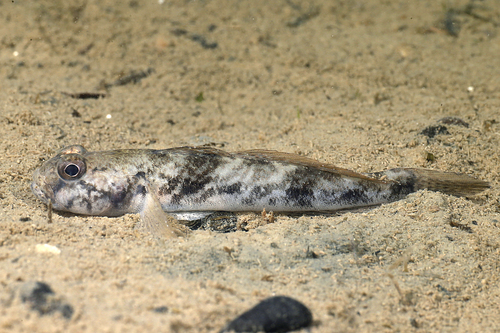
Racer Goby
Babka gymnotrachelus
A master of riverbed camouflage, the Racer Goby is a resilient traveler from the Ponto-Caspian steppe. With its unique 'suction cup' fins and striking diagonal stripes, this small fish is a fascinating subject for any underwater explorer.
Quick Identification
Size
Typically 10-16 cm (4-6 inches), occasionally reaching up to 22 cm (8.5 inches)
Colors
Olive-brown or yellowish-grey with distinctive dark, oblique stripes across the sides; fins are translucent with small dark spots
Key Features
- Slender, elongated body shape
- Distinctive dark diagonal stripes along the flanks
- Fused pelvic fins forming a suction disk
- Eyes positioned high on the head
- Small, terminal mouth
When You’ll See Them
Geographic range
Where Does the Racer Goby Live?
Native to the Ponto-Caspian region of Europe and Asia, the Racer Goby is primarily found in the basins of the Black Sea, Sea of Azov, and the Caspian Sea. Its native range is anchored in countries such as Ukraine, Russia, Romania, and Bulgaria, where it inhabits major river systems like the Dnieper, Dniester, and Danube. In recent decades, the species has significantly expanded its territory westward into Central Europe, establishing robust populations in the Vistula and Rhine river systems through canal networks.
Basemap © OpenStreetMap contributors
Behavior
The Racer Goby is a benthic (bottom-dwelling) fish that thrives in both freshwater and brackish environments. Unlike some of its relatives that prefer rocky crevices, the Racer Goby is a specialist of softer substrates, often found hovering over sand, mud, or fine gravel where its cryptic coloration provides excellent camouflage against predators. They are relatively solitary and spend much of their time perched on their pelvic fins, waiting for prey to drift or crawl by.
During the spawning season, which typically occurs from April to July, males become highly territorial. They seek out cavities under stones or empty mollusk shells to create nests, which they then guard aggressively against intruders. While they are generally peaceful toward humans, they are known for their rapid 'darting' swimming style—short, powerful bursts of speed that help them move between cover or strike at prey.
EverydayEarth exclusive
Camera Tips
To successfully document the Racer Goby, you will need an underwater camera setup, as this fish rarely leaves the bottom of its aquatic habitat. For those using trail cameras or AI-powered wildlife cams, ensure the unit is rated for full submersion and use a weighted mount to prevent the device from drifting in river currents. Position the camera on a sandy or silty patch of the riverbed, ideally near a transition zone like the edge of a weed bed or a cluster of large stones.
Baiting is an excellent way to bring a Racer Goby into focus. Use a small, perforated container filled with bloodworms or crushed aquatic snails and place it directly in front of the lens. The scent will quickly draw these opportunistic feeders from their hiding spots. Because the Racer Goby relies on camouflage, it may sit perfectly still for long periods; setting your AI camera to a high sensitivity for motion detection is recommended to catch the subtle movements of its fins or gills.
Lighting is another critical factor. While they are active during the day, their peak foraging occurs at dawn and dusk when light levels are low. If your camera setup allows, use a dim, warm-toned LED light rather than a bright white flash, which can startle the fish. During the spring spawning season, focus your camera on flat stones or large mollusk shells, as you are likely to capture interesting territorial displays and nesting behaviors from the males.
Similar Species
Species that look similar or are commonly confused with Racer Goby.
Frequently Asked Questions
Record Racer Goby at your habitat
Connect a camera to start building your own species record — AI identifies every visitor automatically.