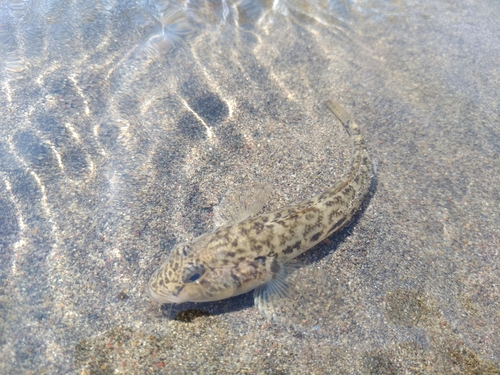
Monkey Goby
Neogobius fluviatilis
A master of the riverbed, the monkey goby is a hardy traveler that has hopped its way across Europe. With its distinctive suction-cup fins and watchful eyes, it offers a fascinating glimpse into the world of benthic freshwater life.
Quick Identification
Size
Typically 7–18 cm (2.8–7.1 inches) in length, occasionally reaching up to 20 cm (7.9 inches).
Colors
Pale sandy-grey or brownish-yellow with a series of dark, elongated spots along the lateral line; fins are often translucent with subtle spotting, while breeding males turn almost entirely black.
Key Features
- Pelvic fins fused into a suction cup on the belly
- Broad, flattened head with high-set, prominent eyes
- Elongated body with two distinct dorsal fins
- Pale, cream-colored underside without dark markings
When You’ll See Them
Geographic range
Where Does the Monkey Goby Live?
The monkey goby is native to the freshwater basins of the northern Black Sea and the Sea of Azov, primarily found in the lower reaches of major rivers such as the Danube, Dnieper, and Dniester. In recent decades, it has significantly expanded its footprint into Central and Western Europe, traveling through shipping canals to colonize the Rhine, Vistula, and Elbe river systems. This expansion has made it a common sight in inland waterways across Germany, Poland, and the Netherlands.
Basemap © OpenStreetMap contributors
Behavior
The monkey goby is a specialized bottom-dweller that spends most of its time resting directly on the substrate. Unlike many open-water fish, it lacks a swim bladder, meaning it moves in short, energetic hops or 'darts' across the riverbed rather than swimming continuously. It is a highly inquisitive species, often seen perched on its suction-cup fins while scanning the surrounding water with its large, mobile eyes.
During the breeding season, which occurs between April and July, the behavior of the monkey goby becomes significantly more complex. Males become intensely territorial, selecting a nesting site under a flat stone or within an empty shell. They perform a dedicated 'guarding' role, fanning the eggs with their fins to ensure oxygenation and protecting the brood from predators until they hatch. Outside of breeding, they are generally peaceful but competitive when foraging for food in sandy pockets.
EverydayEarth exclusive
Camera Tips
To capture the monkey goby on camera, you will need a submersible setup. An action camera in a waterproof housing is the most accessible method. Look for clear, shallow river margins or canal edges where the water flow is slow and the bottom is sandy. Place your camera directly on the substrate, ideally using a weighted mount or a low-profile tripod to prevent it from drifting in the current. Angle the lens slightly downward to focus on the area 12-24 inches in front of the camera.
Since these fish are naturally curious, they are easily attracted to bait. Placing a small mesh bag filled with crushed aquatic snails or worms just inside the frame will often lure a monkey goby into view within minutes. They are 'sit-and-wait' predators, so they may stay in front of the lens for several minutes at a time, providing excellent footage. Natural light is essential for underwater clarity, so aim for midday recording sessions when the sun is directly overhead to penetrate the water column.
If you are using an AI-powered camera with motion detection, be aware that floating debris or swaying aquatic plants can trigger false positives. Position your camera in a 'clean' patch of sand away from heavy vegetation. During the spring, look for large flat rocks; if you see a dark-colored fish darting underneath, you've likely found a male's nesting site. Setting your camera near these hotspots will capture fascinating territorial and parental behaviors that are rarely seen by casual observers.
Similar Species
Species that look similar or are commonly confused with Monkey Goby.
Round Goby
Features a distinct black spot on the first dorsal fin and has a much more robust, rounded body shape.
Racer Goby
Has a more pointed snout and deeper body, with vertical bars often visible on the sides.
Tubenose Goby
Distinguished by small, tube-like nostrils extending over the upper lip.
Frequently Asked Questions
Record Monkey Goby at your habitat
Connect a camera to start building your own species record — AI identifies every visitor automatically.