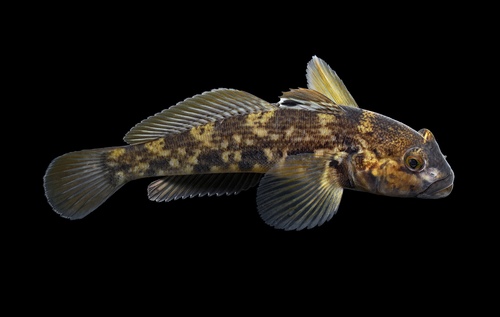
Round Goby
Neogobius melanostomus
A tenacious bottom-dweller with a unique suction-cup grip, the Round Goby is a small fish with a massive ecological impact. From their bulging frog-like eyes to their bold, territorial behavior, these invaders are captivating subjects for underwater discovery.
Quick Identification
Size
Typically 10-15 cm (4-6 inches) in length, though they can reach up to 25 cm (10 inches). Weight ranges from 5-80 grams (0.2-2.8 oz).
Colors
Mottled gray, tan, or olive body with dark brown spots; breeding males turn a distinctive solid jet-black with yellow-edged fins.
Key Features
- Distinctive black spot on the rear of the first dorsal fin
- Fused pelvic fins that form a single suction-cup-like disc
- Large, bulging 'frog-like' eyes on top of the head
- Robust, cylindrical body with a blunt snout
When You’ll See Them
Geographic range
Where Does the Round Goby Live?
The Round Goby is native to the Ponto-Caspian region of Central Eurasia, specifically the brackish and fresh waters of the Black, Azov, and Caspian Seas. Since the late 20th century, it has significantly expanded its footprint as an invasive species, establishing massive populations throughout the North American Great Lakes and their tributaries. It is also found across much of Europe, having spread through major river systems like the Danube, Rhine, and Baltic Sea coastal areas.
Basemap © OpenStreetMap contributors
Behavior
Round Gobies are highly territorial, bottom-dwelling fish known for their aggressive nature and ability to thrive in diverse environments. They lack a swim bladder, which means they don't swim in the traditional sense but rather 'hop' along the bottom in short, quick bursts. Using their specialized suction-cup pelvic fins, they can anchor themselves to rocks and piers, allowing them to remain stationary even in heavy wave action or fast-moving currents.
These fish are notoriously competitive, often driving native species away from prime spawning and feeding grounds. While they are a nuisance to many anglers because they frequently steal bait, they are fascinating to observe due to their boldness. They are known to be fearless, often approaching larger objects—including underwater cameras—to investigate or defend their territory. In the spring and summer, males become intensely focused on guarding nests located in rocky crevices.
EverydayEarth exclusive
Camera Tips
To capture the Round Goby on film, you will need a specialized underwater camera or a standard action camera inside a waterproof housing. Because these are bottom-dwellers, the most effective placement is directly on the substrate. Use a weighted mount or a small tripod to keep the camera steady on the lake or river floor. Position the lens at a slight downward angle toward a flat, rocky clearing or near a crevice between large stones, which are the goby's preferred hiding spots.
Baiting is the single most effective way to attract Round Gobies to your camera. A small mesh bag or a perforated plastic container filled with crushed mussels, nightcrawlers, or even canned corn will draw them in within minutes. Because they are bold and curious, they will often swim directly up to the lens or sit on top of the bait bag, providing excellent close-up opportunities. If you are filming in a high-current area, ensure your camera rig is heavy enough to avoid being swept away, as the gobies will use their suction fins to stay put while your gear might move.
For the best visual results, film during the late spring or early summer when the water is clearest and the males are in their striking black breeding plumage. High-frame-rate settings (60 or 120 FPS) are recommended because their 'hopping' movements are extremely fast and can appear blurry at standard speeds. If filming in deeper, darker water, consider using a small underwater LED light, but be aware that intense light may initially startle them until they habituate to the presence of the equipment.
Similar Species
Species that look similar or are commonly confused with Round Goby.
Frequently Asked Questions
Record Round Goby at your habitat
Connect a camera to start building your own species record — AI identifies every visitor automatically.