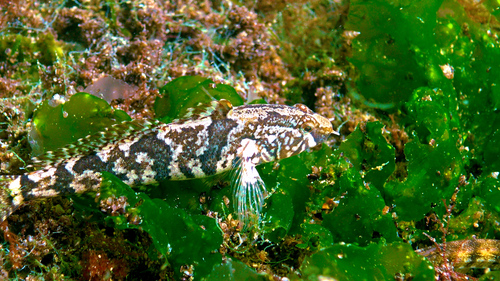
Tubenose Goby
Proterorhinus marmoratus
A master of camouflage with a very peculiar nose, the Tubenose Goby is a fascinating bottom-dweller of the Black Sea basin. These small, marbled fish use their specialized nostrils and suction-cup fins to navigate the rocky shallows of Eurasia's coastlines.
Quick Identification
Size
A small species, typically ranging from 6 to 11.5 cm (2.4 to 4.5 in) in total length.
Colors
Mottled brownish-grey or yellowish-brown with dark, wavy vertical bars or 'marbling' along the sides; cream or white underside; dorsal fins often feature dark spots or stripes.
Key Features
- Two tubular nostrils extending significantly over the upper lip
- Pelvic fins fused into a suction disk on the belly
- Cylindrical body with two distinct dorsal fins
- Marmarated (marbled) color pattern on the flanks
When You’ll See Them
Geographic range
Where Does the Tubenose Goby Live?
The Tubenose Goby is native to the Ponto-Caspian region of Eurasia, specifically inhabiting the brackish waters of the Black Sea, the Sea of Azov, and the Sea of Marmara. Its core range includes the coastal waters and lower river reaches of Ukraine, Russia, Romania, Bulgaria, Georgia, and Turkey. While it is a specialist of the Ponto-Caspian basin, related subspecies have expanded into freshwater systems throughout the Danube drainage and parts of Central Europe.
Basemap © OpenStreetMap contributors
Behavior
The Tubenose Goby is a cryptic, bottom-dwelling species that spends much of its time tucked away in crevices, among aquatic plants, or under submerged rocks. They are relatively sedentary and rely on their excellent camouflage to remain undetected by predators like larger fish and water birds. During the breeding season, males become highly territorial, guarding nesting sites in small cavities or empty shells where females deposit their eggs.
While they are generally shy, they are efficient predators of the benthos. They move in short, jerky bursts along the substrate, using their fused pelvic fins to anchor themselves against currents. In areas where they have been introduced or are highly concentrated, they can be quite bold when foraging, though they rarely interact directly with humans beyond being an occasional, unintentional catch for shore anglers.
EverydayEarth exclusive
Camera Tips
Capturing the Tubenose Goby on camera requires a specialized underwater setup, such as a submersible action camera or an AI-powered underwater 'fish cam' positioned near the substrate. Because these fish are small and rely on camouflage, place your camera very low to the ground—ideally no more than 5 to 10 centimeters above the river or seabed—aimed at a rocky crevice, a patch of submerged vegetation, or an open sandy patch near cover. Using a macro lens or a camera with a close focal point is essential to capture the detail of their namesake tubular nostrils.
To attract them to the camera's field of view, try placing a small amount of bait, such as crushed mussels or bloodworms, inside a mesh bag weighed down near the lens. This will draw them out from their hiding spots and keep them stationary while they forage. Since they are active during the day but also move under the cover of twilight, ensure your camera has a high-quality sensor for low-light conditions. If you are using an AI-powered system, train it to recognize the unique marbled pattern and the two dorsal fins, as these fish often sit motionless for long periods.
Lighting is your best friend when filming this species. In murky brackish water, use an external LED light source positioned at a 45-degree angle to the side of the camera to reduce 'backscatter' (the reflection of light off particles in the water). This side-lighting will also help highlight the 'marble' texture of their skin, making them much easier to distinguish from the surrounding rocks and silt. During the spring spawning season, look for males guarding nests in rocky areas, as they will stay in one spot for days, providing excellent long-term recording opportunities.
Similar Species
Species that look similar or are commonly confused with Tubenose Goby.
Round Goby
Lacks the tubular nostrils and usually has a large, distinct black spot on the first dorsal fin.
Western Tubenose Goby
Nearly identical in appearance but genetically distinct; found primarily in freshwater systems across Europe and North America.
Monkey Goby
Has a more flattened head and lacks the protruding tubular nostrils characteristic of the Proterorhinus genus.
Frequently Asked Questions
Record Tubenose Goby at your habitat
Connect a camera to start building your own species record — AI identifies every visitor automatically.