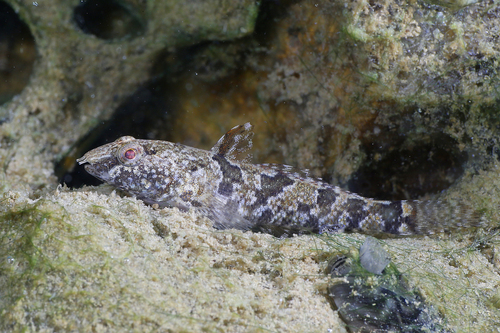
Western Tubenose Goby
Proterorhinus semilunaris
With snorkel-like nostrils and a suction-cup belly, the Western Tubenose Goby is a fascinating master of the riverbed. Once confined to the Black Sea, this resilient little fish is now making a splash in waters across the globe.
Quick Identification
Size
6–12 cm (2.4–4.7 inches) in length; maximum weight is approximately 10–15 grams (0.35–0.53 oz)
Colors
Mottled patterns of light brown, olive, and tan with dark vertical bars along the flanks and a small dark spot at the base of the tail.
Key Features
- Pair of tubular nostrils extending over the upper lip
- Fused pelvic fins forming a suction-like disc
- Broad, flattened head with high-set eyes
- Two distinct dorsal fins, the first with yellowish margins
When You’ll See Them
Geographic range
Where Does the Western Tubenose Goby Live?
Native to the freshwater basins of the Black Sea and Aegean Sea, the Western Tubenose Goby has become a global traveler. While its heartland lies in countries like Ukraine, Bulgaria, and Romania, it has successfully hitched rides in ballast water to reach the Great Lakes of North America and major river systems across Central and Western Europe. This expansion makes it a common sight in temperate freshwater habitats from the Danube to the Detroit River.
Basemap © OpenStreetMap contributors
Behavior
The Western Tubenose Goby is a cryptic bottom-dweller known for its sedentary lifestyle and remarkable ability to blend into its surroundings. Unlike many fish that swim in the water column, this species spends most of its time perched on its pelvic fins, which are fused into a suction cup, allowing it to anchor itself against currents on rocks or submerged logs. It is a highly territorial species, especially during the breeding season when males guard nesting cavities in rocks or empty mollusk shells.
As a 'sit-and-wait' predator, it remains motionless for long periods before darting out to ambush small prey. While they are generally solitary, they can reach high population densities in invasive ranges. They are relatively tolerant of poor water quality and varying salinities, which has contributed to their success as an invasive species in North America and Europe. They rarely interact with humans directly but are frequently encountered by anglers and citizen scientists using underwater cameras.
EverydayEarth exclusive
Camera Tips
Capturing the Western Tubenose Goby requires an underwater setup, such as an action camera in a waterproof housing or a dedicated submersible trail camera. To get the best shots, place your camera in shallow water (1–3 feet deep) near rocky structures or submerged logs, as these fish rarely venture far from cover. Angle the lens slightly downward toward a flat rock or a small sandy clearing between stones where the goby is likely to 'perch' on its suction-cup fins.
Because these fish are small and well-camouflaged, clarity is key. Place your camera in an area with minimal silt to prevent 'backscatter' in your footage. You can encourage a visit by placing a 'bait station' just inside the camera's focal range—a small mesh bag containing crushed snails or frozen bloodworms is highly effective. Be sure to set your camera to a close-focus mode or use a macro lens if available, as the goby's most defining feature, the tubular nostrils, requires a close-up to see clearly.
Lighting is the biggest challenge underwater. If your backyard setup is in a shaded area, consider using a small, diffused waterproof LED light to bring out the mottled brown and gold colors of the fish. Early morning and late afternoon provide the best natural light penetration in shallow water. In invasive regions, look for them in marinas or near piers, as they love the artificial cover provided by human structures.
Similar Species
Species that look similar or are commonly confused with Western Tubenose Goby.
Frequently Asked Questions
Record Western Tubenose Goby at your habitat
Connect a camera to start building your own species record — AI identifies every visitor automatically.