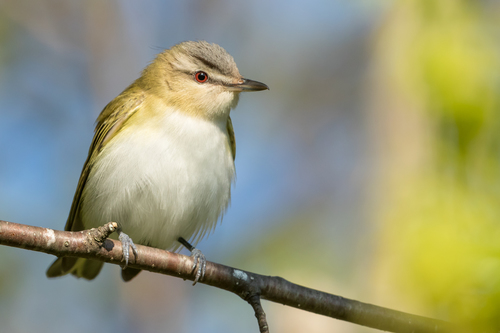
Red-eyed Vireo
Vireo olivaceus
Known as the tireless 'preacher' of the treetops, the Red-eyed Vireo is a master of camouflage with a voice that never quits. Look closely for its sophisticated gray cap and the ruby-red glint in its eye.
Quick Identification
Size
Length: 4.7–5.9 in (12–15 cm); Wingspan: 9.1–9.8 in (23–25 cm); Weight: 0.4–0.9 oz (12–26 g)
Colors
Olive-green back and wings, clean white underparts, and a gray crown. Adult eyes are ruby-red, while juveniles have brown eyes.
Key Features
- Bold white eyebrow stripe bordered by thin black lines
- Striking ruby-red eyes in adults
- Blue-gray legs and feet
- Strong, slightly hooked bill
When You’ll See Them
Behavior
The Red-eyed Vireo is often referred to as the 'preacher bird' due to its habit of singing short, repetitive phrases all day long, even during the sweltering heat of a summer afternoon when other birds have gone quiet. They are tireless vocalists, with some males recorded singing over 20,000 times in a single day. Despite this constant noise, they can be surprisingly difficult to see because their olive-green plumage acts as near-perfect camouflage within the leafy canopy.
These birds are deliberate foragers. Unlike the frantic, hyperactive movements of warblers, a vireo will sit relatively still, scanning the undersides of leaves for caterpillars before making a quick, decisive lunge. They are solitary during the breeding season but are highly migratory, traveling thousands of miles each year to spend the winter in the Amazon basin of South America.
EverydayEarth exclusive
Camera Tips
To capture a Red-eyed Vireo on your backyard camera, you have to bridge the gap between the forest floor and the high canopy. Because they rarely hop along the ground, the best way to get them in frame is by focusing on a high-mounted water source. If you can install a birdbath or a 'dripper' on a deck railing or a pedestal near mature trees, you’ll likely catch them coming down for a midday drink or bath. Mount your camera at eye-level with the water source, ideally 4 to 6 feet away to ensure the AI can trigger on the bird's specific facial markings.
During the late summer months of August and September, move your camera to target native berry-producing shrubs. Species like Elderberry, Serviceberry, and Spicebush are magnets for vireos fueling up for their flight to South America. Position the camera to look through a 'window' in the foliage toward a cluster of ripe berries. Set your camera’s trigger sensitivity to 'High' and use a fast shutter speed or high-frame-rate video setting, as their lunges for fruit are incredibly quick and can result in motion blur on slower devices.
Since Red-eyed Vireos are most active in the dense green of summer, lighting can be a challenge. Try to place your camera in a spot that receives 'dappled' sunlight rather than deep shade or direct, harsh midday sun. If your camera allows for it, use a wide-angle setting to capture the surrounding branches; this provides context for their unique 'look-and-wait' hunting behavior. Avoid using heavy suet or seed baits, as these birds are rarely attracted to standard feeders; instead, focus on the natural 'soft mast' of berries or the presence of moving water.
Similar Species
Species that look similar or are commonly confused with Red-eyed Vireo.
Warbling Vireo
Lacks the bold black-and-white face pattern and gray cap; has a much softer, continuous song.
Black-whiskered Vireo
Nearly identical but has a thin dark 'mustache' stripe on the side of the throat; found only in Florida and the Caribbean.
Philadelphia Vireo
Smaller with a more yellowish wash across the breast and a less distinct facial pattern.
Frequently Asked Questions
Record Red-eyed Vireo at your habitat
Connect a camera to start building your own species record — AI identifies every visitor automatically.