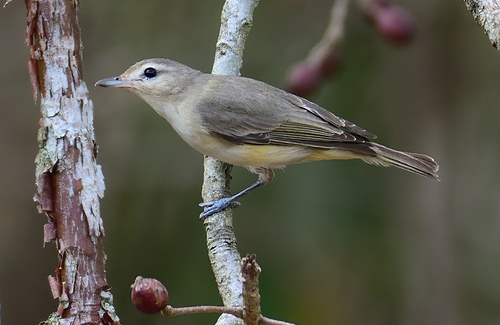
Warbling Vireo
Vireo gilvus
The Warbling Vireo is the tireless soloist of the summer leaves, known for a rambling song that seems to never end. Though they prefer the high canopy, a well-placed water feature can bring these subtle beauties right into your camera's view.
Quick Identification
Size
Length: 4.7–5.1 in (12–13 cm); Wingspan: 8.7 in (22 cm); Weight: 0.3–0.6 oz (10–16 g)
Colors
Plain grayish-olive upperparts and whitish underparts with a subtle yellow wash on the flanks. Features a pale white eyebrow and a dark line through the eye; no wing bars. Males and females look identical.
Key Features
- Plain olive-gray plumage with no wing bars or eye rings
- Distinctive pale white eyebrow (supercilium) and dark eye line
- Short, heavy bill with a small hook at the tip
- Bluish-gray legs and feet
When You’ll See Them
Behavior
The Warbling Vireo is a persistent and cheerful singer of the forest canopy. Unlike many other songbirds that sing primarily from a stationary perch, this vireo often continues its long, rambling song even while foraging or sitting on its nest. They move through the foliage with a slower, more deliberate pace than the frantic hopping of warblers, carefully inspecting the undersides of leaves for insects.
While they are socially monogamous during the breeding season, they are generally solitary or found in pairs. They are not particularly shy of humans and can often be found in suburban parks or backyards with mature trees, though their habit of staying high in the leaves makes them difficult to spot without binoculars. They are highly territorial during the summer and will vigorously defend their nesting sites from other vireos.
EverydayEarth exclusive
Camera Tips
Capturing the Warbling Vireo on a backyard camera requires a strategic approach because these birds spend the majority of their lives high in the tree canopy. To bring them within range of your lens, the most effective lure is water. A bird bath equipped with a 'dripper' or a solar-powered fountain is far more attractive to them than still water, as the sound and motion of the ripples mimic the natural movement of a stream. Position your camera 3 to 5 feet away from the water source at a slight downward angle to capture the bird's head and eye line clearly.
Since Warbling Vireos are not attracted to traditional seed feeders, you should focus your camera placement on the 'edge' habitats of your yard. If you have tall deciduous trees like cottonwoods, maples, or elms, look for spots where lower-hanging branches intersect with a clear line of sight. If you have berry-producing shrubs such as elderberry or serviceberry, set up your camera there during late August and September. This is when vireos descend from the canopy to bulk up on fruit before their long migration to Central America.
In terms of camera settings, use a fast shutter speed or high-frame-rate video to catch their quick movements during bathing. Because they are relatively plain, drab birds, lighting is crucial for identification; aim for a spot that receives bright, indirect morning light to highlight the subtle yellow wash on their flanks and the distinct white eyebrow. If your camera has a 'pre-trigger' or 'buffer' feature, enable it; vireos tend to drop in suddenly and leave just as quickly, and those extra seconds of recorded footage can be the difference between a blurry tail and a perfect profile shot.
Similar Species
Species that look similar or are commonly confused with Warbling Vireo.
Red-eyed Vireo
Has a distinct gray cap bordered by black, and a much brighter red eye in adults.
Philadelphia Vireo
Very similar but has much yellower underparts, especially on the throat and chest.
Tennessee Warbler
Has a thinner, pointier bill and more active, nervous movements compared to the vireo's deliberate pace.
Frequently Asked Questions
Record Warbling Vireo at your habitat
Connect a camera to start building your own species record — AI identifies every visitor automatically.