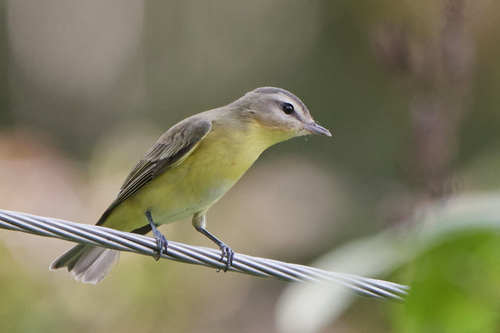
Philadelphia Vireo
Vireo philadelphicus
A hidden gem of the deciduous canopy, the Philadelphia Vireo is a master of camouflage. This migratory visitor delights birders with its soft yellow glow and rhythmic, flute-like song.
Quick Identification
Size
Length: 4.3–5.1 in (11–13 cm); Wingspan: approx 8 in (20 cm); Weight: 0.3–0.4 oz (9–12 g)
Colors
Olive-green upperparts with a greyish crown; yellowish underparts, typically brightest on the throat and breast; dark eye-line and a pale stripe above the eye.
Key Features
- Bright yellow wash concentrated on the throat and breast
- Dark line through the eye with a distinct pale eyebrow
- Small, stout bill with a slightly hooked tip
- Absence of wing bars or a bold eye-ring
When You’ll See Them
Behavior
The Philadelphia Vireo is a methodical and somewhat slow-moving songbird compared to the high-energy warblers it often migrates with. It spends most of its time in the mid-to-upper canopy of deciduous trees, where it moves deliberately along branches to glean insects from the undersides of leaves. This patient foraging style makes it a favorite for patient birdwatchers, though it can be difficult to spot against the green foliage.
During the breeding season, males are persistent singers, often mimicking the phrasing of the Red-eyed Vireo so closely that even experienced ears can be fooled. They are generally solitary or found in pairs during the summer, but during migration, they may join mixed-species flocks. While not overtly fearful of humans, they rarely descend to the ground, preferring the safety and food resources of the treetops.
EverydayEarth exclusive
Camera Tips
Capturing the Philadelphia Vireo on a backyard camera is a rewarding challenge because this species usually stays high in the canopy. To bring them within range of your lens, focus on the two things they descend for: water and berries. A birdbath with a 'wiggler' or a solar-powered fountain is your best tool. The sound of moving water acts as a beacon for migrating vireos. Mount your camera on a fence post or tripod about 3-4 feet away from the water source, angled slightly downward to capture the bird's throat and breast, which are key for identification.
In the fall, these birds look for high-energy snacks. If you have native shrubs like Spicebush, Dogwood, or Serviceberry, position your camera to face a cluster of ripening fruit. Use a high-speed trigger setting or a 'burst' photo mode, as these birds may only drop down for a quick sip or a single berry before retreating to the safety of the leaves. Because they are small and blend in with foliage, ensure your camera is set to its highest resolution (4K if available) so you can zoom in on the subtle eye-line during review.
Early morning light provides the best color accuracy for distinguishing their yellow wash from the paler Warbling Vireo. Try to position your camera with the sun at its back to avoid silhouetting. If your camera allows for focal adjustments, set it to a 'near' or 'macro' range if focusing on a birdbath, as this will help capture the fine details of the bill and plumage that differentiate this species from look-alikes like the Tennessee Warbler.
Similar Species
Species that look similar or are commonly confused with Philadelphia Vireo.
Warbling Vireo
Much paler overall with a white throat, whereas the Philadelphia has a distinct yellow wash on the throat and breast.
Red-eyed Vireo
Larger with a bold grey cap and a red eye; lacks the Philadelphia's yellow underparts.
Tennessee Warbler
Thinner, more pointed bill and shorter tail; lacks the hooked bill tip characteristic of vireos.
Frequently Asked Questions
Record Philadelphia Vireo at your habitat
Connect a camera to start building your own species record — AI identifies every visitor automatically.