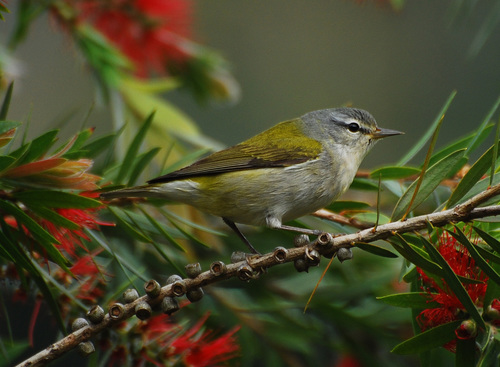
Tennessee Warbler
Leiothlypis peregrina
An energetic traveler of the treetops, the Tennessee Warbler is a master of migration. Watch for its sharp bill and bright white undertail as it visits backyard gardens on its journey from the boreal forest to the tropics.
Quick Identification
Size
4.3–5.1 in (11–13 cm) long; wingspan of 7.5–8.3 in (19–21 cm); weighs 0.3–0.5 oz (8–13 g)
Colors
Breeding males have a sharp gray cap, white eyebrow, and olive-green back. Females and non-breeding birds are more uniform olive-yellow.
Key Features
- Thin, very sharp-pointed bill
- Distinctive white line over the eye (supercilium)
- Bright white undertail coverts (essential for ID from below)
- Completely lacks wing bars or tail spots
When You’ll See Them
Behavior
In the winter, its behavior shifts dramatically. It becomes highly social, joining mixed-species flocks and visiting flowering trees to drink nectar. It uses its uniquely sharp bill to pierce the base of flowers or probe hummingbird feeders. In a backyard setting, they are most often seen flitting through the mid-to-upper canopy of deciduous trees, rarely staying still for more than a few seconds at a time.
EverydayEarth exclusive
Camera Tips
To capture a Tennessee Warbler on your AI camera, you must focus on their love for water and high-energy foraging. These birds are rarely interested in standard seed feeders, but they are highly attracted to the sound of moving water. Position your camera near a birdbath equipped with a 'wiggler' or a solar-powered fountain. Set the camera at a slight upward angle, roughly 2-3 feet from the water source, to capture the diagnostic white undertail coverts as they dip and dive.
Because these warblers are exceptionally fast, your camera settings are critical. Use a 'Fast' trigger speed setting if available, and set the capture mode to a 5-10 second video clip or a multi-shot burst. Tennessee Warblers often visit 'sap wells' created by woodpeckers; if you have a tree with active sapsucker holes, mounting your camera nearby can provide a unique look at these birds feeding on both the sap and the insects attracted to it.
In the fall, these birds are much more yellowish and can be easily confused with other species. To get the best identification footage, place your camera in an area that receives bright, indirect morning light. Avoid placing the camera where it faces the direct sun, which can wash out the subtle olive-green tones of their plumage. If you live in a southern climate where they winter, try placing a camera near nectar-rich plants like Salvia or even near a hummingbird feeder, as they are known to steal a quick drink.
Similar Species
Species that look similar or are commonly confused with Tennessee Warbler.
Orange-crowned Warbler
Orange-crowned Warblers have yellow undertail coverts and blurry streaks on the breast, whereas Tennessee Warblers have white undertail coverts and unstreaked breasts.
Red-eyed Vireo
The Red-eyed Vireo is larger with a thicker, hooked bill and a much bolder black border around its gray cap.
Warbling Vireo
Warbling Vireos have a much thicker, blunt-tipped bill and lack the sharp, pointy appearance of the Tennessee Warbler's face.
Frequently Asked Questions
Record Tennessee Warbler at your habitat
Connect a camera to start building your own species record — AI identifies every visitor automatically.