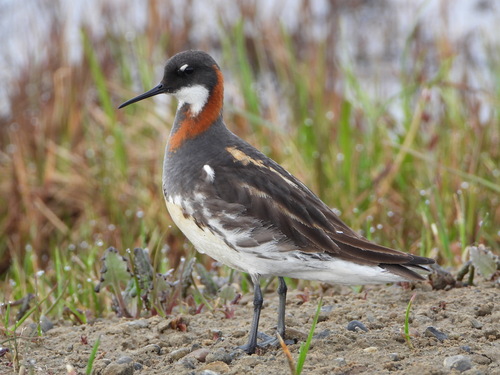
Red-necked Phalarope
Phalaropus lobatus
A tiny, needle-billed wanderer that spins like a top on the water, the Red-necked Phalarope is a marvel of the Arctic that spends its winters on the open ocean.
Quick Identification
Size
Length: 17–19 cm (6.7–7.5 in); Wingspan: 30–34 cm (12–13 in); Weight: 20–48 g (0.7–1.7 oz)
Colors
Females are more brightly colored with a slate-grey back, white throat, and a bold chestnut-red patch on the neck. Males are similar but duller and more brown.
Key Features
- Needle-thin black bill
- Bright chestnut-red patch on sides of neck
- White throat and dark eye mask
- Lobed toes for swimming and spinning
When You’ll See Them
Geographic range
Where Does the Red-necked Phalarope Live?
Native to the circumpolar north, the Red-necked Phalarope breeds across the vast Arctic tundras of Canada, Alaska, Russia, and Northern Europe. As a highly migratory species, it travels thousands of miles to spend its winter on the open waters of the Pacific and Indian Oceans, particularly off the coasts of Peru and the Arabian Sea. During migration, these birds are frequent visitors to inland wetlands and saline lakes across the midwestern and western United States.
Basemap © OpenStreetMap contributors
Behavior
In a rare reversal of avian gender roles, this species practices polyandry. The females are larger and more brightly colored; they compete for mates and may defend several males. Once the eggs are laid, the female often leaves to find another mate, leaving the duller-colored male to handle all the incubation and chick-rearing duties. These birds are also incredibly comfortable at sea, spending their winters floating on tropical ocean currents.
EverydayEarth exclusive
Camera Tips
To capture the Red-necked Phalarope on camera, placement is everything. These birds spend nearly all their time on the water rather than the shore, so you should position your camera on a low-profile mount or mini-tripod at the very edge of a marsh, salt pond, or tundra pool. Setting the lens just 3-5 inches above the water line provides an intimate, immersive perspective that highlights their unique swimming posture and the 'spinning' vortex they create while feeding.
Since these birds are attracted to high concentrations of aquatic invertebrates, look for shallow pools with visible insect activity or brine shrimp. You don't need artificial bait; instead, look for 'scum lines' or areas where the wind pushes surface debris, as Phalaropes often forage along these edges. Use a high shutter speed or a camera capable of 60fps video to freeze the action of their rapid-fire pecking and spinning, which can be surprisingly fast for such a small bird.
Phalaropes are generally less shy than other shorebirds and may swim quite close to a stationary camera. Ensure your device is in a high-quality waterproof housing, as splashing is inevitable. For the best lighting, aim for the 'golden hours' of early morning or late afternoon, which will make the white throat and the namesake red neck patch pop against the water. If you are using an AI-triggered camera, set the motion zones to the water's surface rather than the muddy banks.
Similar Species
Species that look similar or are commonly confused with Red-necked Phalarope.
Frequently Asked Questions
Record Red-necked Phalarope at your habitat
Connect a camera to start building your own species record — AI identifies every visitor automatically.