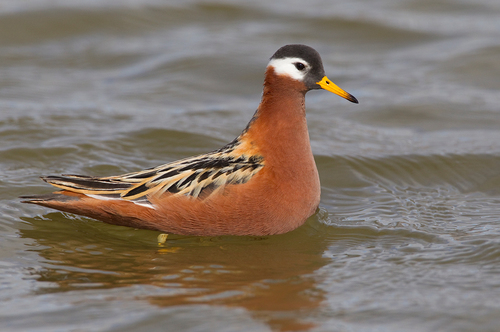
Red Phalarope
Phalaropus fulicarius
A champion of the high seas and the Arctic tundra, the Red Phalarope breaks all the rules. Known for its striking red summer dress and its mesmerizing 'spinning' hunt, this tiny voyager spends most of its life miles away from land on the open ocean.
Quick Identification
Size
Length: 20–22 cm (7.9–8.7 in); Wingspan: 37–41 cm (15–16 in); Weight: 40–75 g (1.4–2.6 oz)
Colors
Breeding females have deep rufous-red underparts, white cheek patches, and a yellow bill with a black tip. Males are duller. In winter, both sexes are pale grey above and white below.
Key Features
- Thick, yellow bill with a black tip (breeding season)
- Unique spinning behavior on water
- Lobed toes for swimming
- Reverse sexual dimorphism (females are brighter than males)
- Pale grey winter plumage with a distinct dark eye smudge
When You’ll See Them
Geographic range
Where Does the Red Phalarope Live?
The Red Phalarope is a true denizen of the high North, breeding across the Arctic reaches of North America, Greenland, Iceland, and Eurasia. When summer ends, these birds embark on an incredible southward migration that takes them almost exclusively over the open ocean rather than following inland routes. They spend their winters in the nutrient-dense waters off the coasts of western South America and West Africa, making them one of the most widely traveled waders in the world.
Basemap © OpenStreetMap contributors
Behavior
The Red Phalarope is a fascinating study in reversed gender roles. Unlike most bird species, the females are the larger, more colorful ones who compete for mates and defend territories. Once the eggs are laid, the female often leaves to find another mate, leaving the more camouflaged male to incubate the eggs and raise the chicks alone. This species is highly aquatic and spends more time swimming than almost any other shorebird.
In the water, they exhibit a famous 'spinning' behavior, swimming rapidly in tight circles to create a small whirlpool. This vortex sucks aquatic invertebrates and plankton toward the surface, making it easy for the bird to pick them up with its bill. They are also remarkably 'tame' compared to other shorebirds, often allowing observers or cameras to get within a few feet without showing signs of alarm.
During the non-breeding season, these birds are almost entirely pelagic, meaning they live on the open ocean. They congregate in large flocks where nutrient-rich currents meet, often resting on the water like tiny gulls. Their social nature is most evident during migration, when they travel in dense groups across vast oceanic stretches.
EverydayEarth exclusive
Camera Tips
Capturing the Red Phalarope requires a focus on water. Because these birds prefer swimming to wading, place your camera at the very edge of a tundra pool or a coastal lagoon. To get the most intimate shots, mount the camera just 2–3 inches above the water level using a ground spike or a weighted waterproof housing. This low-angle perspective captures their unique spinning behavior and the beautiful reflections of their rufous breeding plumage.
If you are monitoring a shoreline, look for areas where seaweed or kelp has washed up, as these 'wrack lines' attract the small invertebrates Phalaropes love. Set your camera to a fast shutter speed (at least 1/1000s) to freeze the motion of their rapid pecking and the water droplets they kick up while spinning. Because they are often active in bright, reflective environments, you may need to adjust your exposure compensation down slightly to avoid blowing out the white patches on their faces.
While they don't respond to traditional birdseed, you can attract them during migration by providing a very shallow, still-water feature if your property is right on the coast. However, their presence is often dictated by weather; 'wreck' events after coastal storms can bring them inland to unusual locations. During these times, keep your camera ready for unexpected visitors in flooded fields or suburban ponds. Use a wide-angle lens if you want to capture their lack of fear—they will often walk or swim right up to a stationary camera.
Similar Species
Species that look similar or are commonly confused with Red Phalarope.
Red-necked Phalarope
Smaller with a much thinner, needle-like bill and darker, streaked plumage in winter.
Wilson's Phalarope
Larger with a significantly longer, thinner bill; lacks the red underparts and prefers inland freshwater habitats.
Sanderling
A similar size and color in winter, but the Sanderling is a 'runner' on sandy beaches rather than a swimmer.
Frequently Asked Questions
Record Red Phalarope at your habitat
Connect a camera to start building your own species record — AI identifies every visitor automatically.