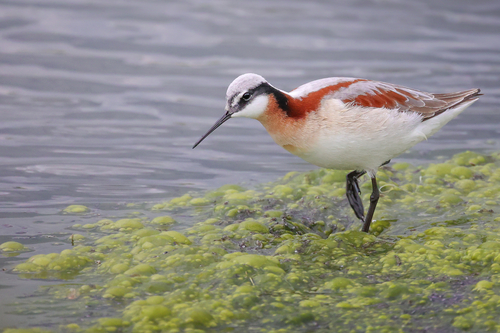
Wilson's Phalarope
Phalaropus tricolor
The Wilson's Phalarope is a shorebird that breaks all the rules, featuring brightly colored females and a unique 'vortex' feeding dance. This long-distance traveler migrates from the North American prairies all the way to the salt lakes of the Andes.
Quick Identification
Size
Length: 22–24 cm (8.7–9.4 in); Wingspan: 35–43 cm (14–17 in); Weight: 38–110 g (1.3–3.9 oz)
Colors
Breeding females are more vibrant with gray and cinnamon necks and a black eye stripe; males are duller versions. Non-breeding adults are pale gray above and white below.
Key Features
- Long, needle-like black bill
- Distinctive habit of spinning in circles on the water to feed
- Females are larger and more colorful than males
- White rump visible in flight without a wing bar
When You’ll See Them
Geographic range
Where Does the Wilson's Phalarope Live?
Wilson's Phalarope is a native of the Americas, breeding across the northern prairies of western Canada and the western United States. As a highly migratory species, it travels vast distances to spend the winter in the high-altitude salt lakes of the Andes in Argentina, Bolivia, and Chile. During their spring and fall journeys, they are common passage migrants throughout the American Southwest, Mexico, and Central America.
Basemap © OpenStreetMap contributors
Behavior
Wilson's Phalaropes are famous for their role-reversal in social structure. In a rare twist for the bird world, the females are the ones who sport the bright plumage and compete for the attention of males. After the female lays the eggs, she often departs to find a new mate, leaving the male to handle all the incubation and chick-rearing duties entirely on his own.
These birds exhibit a fascinating foraging technique known as 'vortex feeding.' By swimming in tight, rapid circles on the surface of shallow water, they create a miniature whirlpool that sucks up aquatic insects and larvae from the bottom, making them easy to pick off with their needle-thin bills. They are highly social outside of the breeding season, forming massive flocks that can number in the hundreds of thousands at major salt lakes during migration.
EverydayEarth exclusive
Camera Tips
To capture the best footage of a Wilson's Phalarope, position your camera at a very low angle, ideally just 6 to 12 inches above the water line. This perspective highlights their delicate, needle-like bills and the unique way they sit high on the water like tiny gulls. Focus your lens on shallow edges or mudflats where water is less than four inches deep, as this is where they are most likely to perform their signature spinning dance.
Because the 'spinning' behavior is quite rapid, set your camera to a high trigger speed or use a high-frame-rate video setting (at least 30fps or 60fps). If your AI camera supports pre-roll or 'burst' mode, enable it; the sudden movement of a phalarope entering the frame can be missed by slower sensors. If you are using a trail camera, a 20-30 second video clip is much more valuable than a still photo for documenting their specialized feeding techniques.
Placement near temporary spring pools or 'prairie potholes' is ideal during the months of May and August. These birds are not typically attracted to standard bird feeders, but they are highly drawn to water sources with natural insect life. Avoid using bright white flash at night as they are diurnal, and focus on capturing the soft morning or late afternoon light which brings out the cinnamon tones in the female’s neck feathers without blowing out the highlights on their white bellies.
Similar Species
Species that look similar or are commonly confused with Wilson's Phalarope.
Red-necked Phalarope
Smaller with a shorter, slightly thicker bill and a darker back in breeding plumage.
Red Phalarope
Features a much thicker, yellowish bill and is more commonly found in coastal/oceanic environments.
Lesser Yellowlegs
Has bright yellow legs and a different foraging style, walking through water rather than swimming and spinning.
Frequently Asked Questions
Record Wilson's Phalarope at your habitat
Connect a camera to start building your own species record — AI identifies every visitor automatically.